

 James Rivera

Ángel Boligán Corbo (born May 10, 1965, in San Antonio de los Baños, La Habana, Cuba) is an internationally acclaimed Cuban cartoonist, illustrator, and caricaturist, celebrated for his sharp humor, philosophical reflections, and humanistic approach to visual satire.
Boligán’s cartoons transcend language and culture, offering a unique fusion of poetry, irony, and surrealism. His work, rich in symbolism and emotional depth, has earned him over 180 international awards and positioned him among the world’s most respected contemporary cartoonists.
Infobox: Ángel Boligán Corbo
| Full Name | Ángel Boligán Corbo |
|---|---|
| Born | May 10, 1965 — San Antonio de los Baños, La Habana, Cuba |
| Nationality | Cuban |
| Occupation | Cartoonist · Illustrator · Editorial Artist |
| Fields | Political Satire · Caricature · Graphic Humor |
| Education | Escuela Nacional de Instructores de Arte, Havana (1980s) |
| Residence | Mexico City, Mexico |
| Known for | Espejo de Tinta column in El Universal; Surreal and symbolic political cartoons |
| Affiliations | – Cartooning for Peace (Paris, France) – CAGLECARTOONS INC. (USA) – Unión Nacional de Escritores y Artistas de Cuba (UNEAC) – Founder of Cartonclub – El Club de la Caricatura Latina |
| Exhibitions | – “Eduardo Abela” Gallery (1981) – Boligán Humor Villamil (1990) – Bolicaturas (1991) |
| Major Awards | – Grand Prix & 1st Prize – World Press Cartoon, Portugal (2006) – Gold Medal – WINE International Invitation, China (2005) – Grand Prize – XIII Bienal Internacional del Humor, Cuba (2003) – 1st Prize – Portocartoon World Festival, Portugal (2000) – Multiple Awards – Salón Internacional del Humor de Piracicaba, Brazil (2013 – 2015) |
| Collections | – Casa del Humor y la Sátira, Gabrovo, Bulgaria – Museo del Humor, San Antonio de los Baños, Cuba |
| Years Active | 1980 – present |
| Website / Profile | Cartoonist Network Profile |
Early Life and Education
Ángel Boligán was born in San Antonio de los Baños, a town known as the cradle of Cuban humor and the birthplace of many of the country’s best artists. From an early age, Boligán showed a fascination with art, storytelling, and human behavior.
In the 1980s, he graduated from the Escuela Nacional de Instructores de Arte in Havana, Cuba. His formal training laid the foundation for his technical mastery and deep philosophical vision. He was influenced by both Latin American surrealism and European political satire, creating a distinctive visual language that merges elegance and irony.

Career and Artistic Journey
Boligán began exhibiting his work in the early 1980s, participating in both local and international art contests. His first solo exhibition was held in 1981 at the Galería Eduardo Abela in his hometown.
Early Exhibitions
- 1981: “Eduardo Abela Gallery,” San Antonio de los Baños, Cuba
- 1990: “Boligán Humor Villamil,” Provincial Museum of Ciego de Ávila, Cuba
- 1991: “Bolicaturas,” Taberna del Tío Cabrera, San Antonio de los Baños
From the beginning, Boligán’s work revealed his gift for transforming ordinary realities into profound metaphors about humanity, society, and freedom.
International Recognition and Collective Exhibitions
During the 1980s, Boligán’s art began gaining recognition abroad. He participated in numerous International Humor Biennials, including:
- III Bienal Internacional de Humorismo, Havana (1983)
- VI and VII Bienal Internacional del Humor y la Sátira en el Arte, Gabrovo, Bulgaria
- Yomiuri Shimbun International Cartoon Contest, Tokyo, Japan (1985)
By the end of the decade, he was already considered one of the most promising voices in Cuban graphic humor. His participation in events such as the Salón Nacional de Humorismo Gráfico “Horacio Rodríguez Suría” and the Bienales Internacionales del Humorismo solidified his place within the Cuban art scene.
The Mexican Chapter: New Horizons
In the 1990s, Boligán settled in Mexico, where he continued to expand his artistic career and reach an international audience. He became a regular contributor to the Mexican newspaper El Universal, where his column “Espejo de Tinta” (Mirror of Ink) became one of the most influential visual editorials in Latin America.
His powerful, minimalist compositions and evocative symbolism resonated deeply with readers. Through Espejo de Tinta, Boligán explored global themes such as war, inequality, migration, consumerism, love, technology, and freedom of expression.
He also contributed to numerous international publications, making him one of the most widely published Latin American cartoonists of his generation.
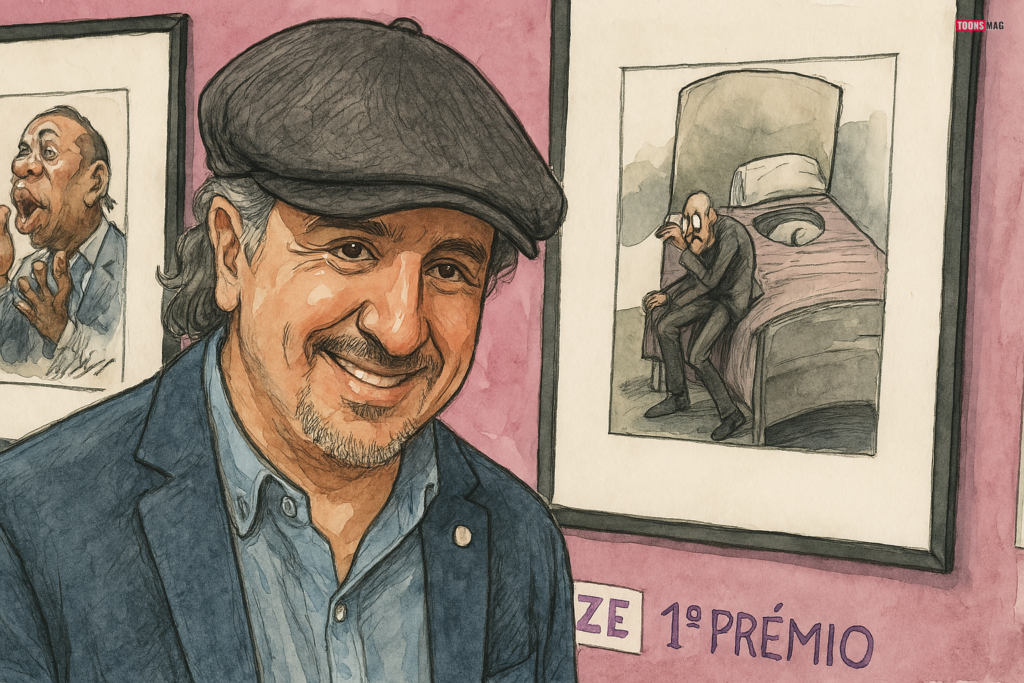
Artistic Philosophy: Between Irony and Humanism
Ángel Boligán’s art operates in the territory between humor and reflection, where irony becomes a tool for compassion and truth. His characters—often faceless, universal human figures—move in surreal spaces filled with metaphors: cages, clocks, wings, roots, and mirrors.
He describes humor as “a universal language of human intelligence,” a bridge connecting cultures through laughter and thought.
His work combines:
- Visual poetry: drawings that tell stories beyond words
- Social critique: reflections on modern society’s contradictions
- Aesthetic minimalism: using clean lines and shadows to evoke emotion
Boligán once said:
“A good cartoon doesn’t shout; it whispers to your conscience.”
Memberships and Collaborations
Boligán is an active member of several prestigious artistic organizations:
- CAGLECARTOONS, INC. (USA) – International Syndicate of Cartoonists
- Cartooning for Peace (France) – Network founded by Plantu and supported by the United Nations
- Unión Nacional de Escritores y Artistas de Cuba (UNEAC)
- Founder of CARTONCLUB – The Club of Latin American Caricature, an independent platform uniting Latin cartoonists to promote visual humor and artistic exchange.
Through Cartooning for Peace and Cartonclub, Boligán has helped foster global dialogue about the role of cartoons in promoting democracy, peace, and cultural understanding.

Awards and Distinctions
Throughout his career, Ángel Boligán has received more than 180 international awards and honorable mentions. His remarkable list of distinctions includes prizes from Europe, Asia, and the Americas.
Some of the most notable include:
- 1987: Third Prize, VIII Bienal Internacional del Humor y la Sátira en el Arte, Gabrovo, Bulgaria
- 1995: First Prize in General Humor and Four Special Awards, IX Bienal Internacional del Humor, Cuba
- 2000: First Prize, Portocartoon World Festival, Porto, Portugal
- 2003: Grand Prize, XIII Bienal Internacional del Humor, Cuba
- 2005: Gold Medal and Award for Excellence, The 2nd WINE International Invitation, China
- 2006: Grand Prix and First Prize, World Press Cartoon, Sintra, Portugal
- 2007: Excellence Award, United Nations Ranan Lurie Political Cartoon Awards
- 2011: Second Prize, World Press Cartoon, Portugal
- 2013: Second Prize, 15th Portocartoon World Festival, Portugal
- 2015: First Prize, Niels Bugge Cartoon Contest, Denmark
- 2015: First Prize, 42nd Salón Internacional del Humor de Piracicaba, Brazil
- 2015: First Prize, OSTEN World Gallery of Cartoons, Macedonia
Boligán has also received Medals of Excellence from the Society for News Design (SND, USA) and numerous awards for editorial illustration.
Exhibitions and Legacy in Museum Collections
His artworks are permanently exhibited in:
- The House of Humor and Satire, Gabrovo, Bulgaria
- The Museum of Humor, San Antonio de los Baños, Havana, Cuba
Boligán’s exhibitions—held across Europe, Asia, and the Americas—continue to attract both art critics and general audiences who admire his ability to distill complex truths into a single, elegant image.
Themes and Motifs in His Work
1. Freedom and Human Rights
Boligán often depicts birds, open cages, and broken chains to symbolize the eternal human desire for freedom.
2. Technology and Isolation
He uses smartphones, cables, and screens as symbols of modern alienation—humans trapped in their own inventions.
3. Love and Existence
Romantic and existential themes appear frequently in his art, blending tenderness with melancholy.
4. Environmental Concerns
Trees, roots, and earth motifs reveal his deep ecological awareness and respect for nature.
5. Political Power and Corruption
Without resorting to aggression, Boligán exposes hypocrisy and greed through subtle yet devastating irony.
Influence and Cultural Impact
Ángel Boligán is regarded as one of the great masters of contemporary graphic humor, alongside figures such as Jean Plantu (France) and Antonio Antunes (Portugal). His work has influenced new generations of cartoonists across Latin America, Europe, and Asia.
He has served as a jury member in international cartoon contests, including the Toons Mag International Cartoon Contest, which promotes freedom of expression and human rights through art.
His drawings have been featured in international exhibitions like Freedom of Expression, Women’s Rights, and Equal Rights—organized by Toons Mag and Cartoonist Network to defend universal values of equality and justice.
Personal Style and Symbolism
Boligán’s signature style blends surrealism with deep human empathy. His color palette—often monochromatic—emphasizes form and concept over aesthetic excess. Each image invites contemplation rather than instant laughter.
His works have been described as “philosophical metaphors drawn in ink.” Through the absence of words, he speaks directly to the soul of the viewer.

Legacy and Continuing Relevance
Today, Ángel Boligán continues to live and work in Mexico City, where he creates new works, mentors young artists, and exhibits globally. His art remains a mirror of our time—one that reflects both beauty and contradiction.
As the founder of Cartonclub, he has cultivated a creative community of Latin artists who believe in the transformative power of humor.
Selected Awards Summary
| Year | Award | Country | Category |
|---|---|---|---|
| 1987 | 3rd Prize, Bienal Internacional del Humor y la Sátira | Bulgaria | Humor |
| 1995 | 1st Prize, IX Bienal Internacional del Humor | Cuba | General Humor |
| 2000 | 1st Prize, Portocartoon World Festival | Portugal | Editorial Cartoon |
| 2003 | Grand Prize, XIII Bienal Internacional del Humor | Cuba | Satire |
| 2006 | Grand Prix, World Press Cartoon | Portugal | Political Cartoon |
| 2007 | Excellence Award, UN Ranan Lurie Awards | USA | Political Cartoon |
| 2011 | 2nd Prize, World Press Cartoon | Portugal | Caricature |
| 2013 | 2nd Prize, Portocartoon World Festival | Portugal | Humor |
| 2015 | 1st Prize, Niels Bugge Cartoon Contest | Denmark | Environmental Theme |
| 2015 | 1st Prize, Salón Internacional del Humor de Piracicaba | Brazil | Opinion |
| 2015 | 1st Prize, OSTEN World Gallery of Cartoons | Macedonia | Digital Humor |