
 Liam Morris

DC Comics (originally DC Comics, Inc., and commonly just DC) is an American comic‑book publisher owned by DC Entertainment, a subsidiary of Warner Bros. Discovery. The name DC originates from Detective Comics, first published in 1937. DC is one of the largest and oldest comics publishers in the U.S., with its first book under the DC banner appearing in 1937.
Most DC stories take place in the shared DC Universe (DCU), home to culturally iconic heroes—Superman, Batman, Wonder Woman, The Flash—and flagship teams like the Justice League, Teen Titans, Suicide Squad, and the Legion of Super‑Heroes. DC’s rogues gallery includes Lex Luthor, The Joker, Darkseid, and anti‑heroes such as Catwoman. DC also publishes acclaimed works outside mainline continuity under labels such as Vertigo and DC Black Label (e.g., Watchmen, V for Vendetta, Fables).
DC’s New York offices historically moved among several Midtown addresses before the company’s headquarters relocated in 2015 to 4000 Warner Boulevard, Burbank, California. In the direct market, DC is distributed by Lunar Distribution, with Penguin Random House Publisher Services handling bookstore distribution. In 2017, DC and its long‑time competitor Marvel accounted for the majority share of the U.S. comic‑book periodical market; when all book sales (including graphic novels) are counted, DC ranks second after Viz Media in the U.S., with Marvel third.
Quick Facts (Infobox): DC Comics
| Parent | DC Entertainment (a division of Warner Bros. Discovery) |
|---|---|
| Status | Active |
| Founded | 1935 (as National Allied Publications); 1937 (as Detective Comics); 1939 (as All‑American Publications); 1946 (as National Comics Publications); 1961 (as National Periodical Publications); 1977 (as DC Comics) |
| Founders | Malcolm Wheeler‑Nicholson, Harry Donenfeld, Jack Liebowitz, Max Gaines |
| Country | United States |
| HQ | 4000 Warner Blvd., Burbank, California |
| Distribution | Lunar Distribution (direct market); Penguin Random House Publisher Services (book trade) |
| Key People | Jim Lee (President, Publisher, CCO); Anne DePies (SVP, GM); Marie Javins (Editor‑in‑Chief) |
| Employees | ~230 |
| Official Site | dc.com |
Market & Distribution Snapshot
- Market position: DC and Marvel together represent the majority of U.S. periodical comics sales; when graphic‑novel and manga channels are included, DC typically ranks among the top three North American comics publishers.
- Retail channels: Direct‑market comic shops (weekly), U.S./international book trade, mass retail, libraries, and digital storefronts. DC shifted U.S. direct‑market distribution in 2020–2021 and today primarily uses Lunar Distribution; Penguin Random House handles bookstore distribution.
- Formats: Periodicals (standard and card‑stock covers), prestige one‑shots, trade paperbacks, hardcovers (Deluxe, Absolute, Compendium, Omnibus), facsimile editions, and digest/compact lines (e.g., DC Compact Comics).
Signature Crossover Events (Chronological Highlights)
- Crisis on Infinite Earths (1985–1986) — Streamlined the Multiverse; foundational post‑Crisis canon.
- Zero Hour: Crisis in Time (1994) — Timeline repair; continuity clean‑up.
- Infinite Crisis (2005–2006) — Revisits Multiverse legacy; reshapes teams and status quos.
- Final Crisis (2008) — Meta‑narrative on evil and myth (Darkseid centerpiece).
- Blackest Night / Brightest Day (2009–2011) — Lantern‑spectrum epic; line‑wide tie‑ins.
- Flashpoint (2011) → The New 52 relaunch (2011–2016) — Entire line reset with 52 core titles.
- Rebirth (2016–2017) — Restores legacy and connective tissue post‑New 52.
- Dark Nights: Metal (2017–2018) & Death Metal (2020–2021) — Dark Multiverse; narrative bridge to Omniverse concepts.
- Doomsday Clock (2017–2019) — Integrates Watchmen concepts into DCU continuity.
- Infinite Frontier (2021) — Post‑Death Metal status quo; “everything happened” ethos.
- Dark Crisis on Infinite Earths (2022) — Multiversal stakes; Justice League absence.
- Dawn of DC (2023–present) — New jump‑on era across core franchises.
Multiverse, Hypertime & the Omniverse (Quick Primer)
- Earth designations: Classic Earth‑1/Earth‑2 (Silver/Golden Ages), evolving to a curated 52‑Earth model, then to a dynamic Multiverse/Omniverse where past continuities and Elseworlds can coexist.
- Elseworlds/Black Label: Out‑of‑continuity or mature‑readers stories that experiment with tone, era, and genre.
Media, DC Studios & Brand Extensions
- Film eras:
- Superman (1978–1987) and Batman (1989–1997) opened mainstream cinema to superheroes.
- The Dark Knight Trilogy (2005–2012) elevated grounded, auteur‑driven storytelling.
- Shared‑universe cycles (2013–2023) included Man of Steel, Wonder Woman, Aquaman, Shazam!, and more.
- DC Studios leadership era (from 2022) signaled a strategic slate‑planning approach to a unified screen continuity.
- Animation & TV: Influential series like Batman: The Animated Series, Superman: TAS, Justice League/Unlimited, Young Justice, Teen Titans, plus long‑running live‑action franchises (Arrowverse, Gotham, Pennyworth, Titans, Peacemaker).
- Games & interactive: Flagship titles include Batman: Arkham series, Injustice franchise, and multiple mobile/console tie‑ins.
- Streaming: A consolidated DC hub on Warner Bros. Discovery platforms; archival animated features remain a key pillar.
Digital Publishing & Subscription
- Day‑and‑date digital parity across major storefronts.
- DC Universe Infinite offers catalog reading, curated collections, and digital‑first initiatives.
- Past digital experiments include DC2 and DC2 Multiverse for panel layering and branching narratives.
Collecting & Archival Programs
- Deluxe/Omnibus/Absolute lines remaster seminal runs and events; Compendiums collect large eras cost‑effectively.
- Facsimile Editions reproduce key historical issues with period ads and original trade dress.
- Library adoption: Strong presence in school/public libraries via YA/Kids graphic‑novel lines and educator guides.
Influential Creators & Editors (Selected)
- Foundational: Jerry Siegel & Joe Shuster; Bob Kane & Bill Finger; Gardner Fox; Julius Schwartz; Jack Kirby.
- Bronze/Modern: Neal Adams; Denny O’Neil; Marv Wolfman & George Pérez; Frank Miller; Alan Moore & Dave Gibbons; Grant Morrison; Neil Gaiman; Mark Waid; Geoff Johns.
- Contemporary voices: Scott Snyder & Greg Capullo; Tom King; Gail Simone; Brian Michael Bendis; James Tynion IV; Joshua Williamson; Ram V; Joëlle Jones; Jorge Jiménez; Nicola Scott; Cliff Chiang.
Essential Reading Roadmap (Jump‑On Picks)
- Superman: All‑Star Superman; Birthright; For All Seasons; The Death & Return of Superman; Superman: Up in the Sky.
- Batman: Year One; The Long Halloween; Hush; Court of Owls; The Killing Joke (mature); White Knight (Black Label).
- Wonder Woman: George Pérez run; The Hiketeia; Rucka runs; Azarello/Chiang (New 52); Historia (Black Label).
- Green Lantern: Rebirth; Sinestro Corps War; Blackest Night/Brightest Day.
- The Flash: The Flash: Year One (modern retellings vary); The Flash: Rebirth; Flashpoint.
- Justice League / DCU: JLA (Morrison); Kingdom Come; New Frontier; Crisis on Infinite Earths; Infinite Crisis.
Awards & Recognition (High Level)
- Multiple Eisner and Harvey wins across decades for creators and titles including Watchmen, The Sandman, All‑Star Superman, Batman runs, and more.
Community, Access & Inclusion
- Free Comic Book Day participation; retailer exclusives and variant programs.
- Kids/YA lines expand literacy outreach; growing representation across characters, teams, and creators.
Tip: New readers can safely start at era jump‑on points (e.g., Rebirth, Infinite Frontier, Dawn of DC) or with evergreen stand‑alones listed above.## What DC Comics Publishes
- Ongoing series & limited series in a shared continuity (DCU)
- Graphic novels (original and collected editions)
- All‑ages & YA lines (e.g., DC Graphic Novels for Kids & Young Adults)
- Prestige & mature readers material under DC Black Label and (historically) Vertigo
Names & Corporate Evolution (Timeline)
- 1935 — National Allied Publications founded by Major Malcolm Wheeler‑Nicholson; debuts with the tabloid New Fun: The Big Comic Magazine.
- 1937 — Detective Comics launches; Detective Comics, Inc. formed with financier Harry Donenfeld and accountant Jack S. Liebowitz.
- 1939 — Max Gaines forms affiliate All‑American Publications.
- 1946 — All‑American merges with Detective Comics, Inc. into National Comics Publications.
- 1961 — Consolidation under National Periodical Publications (NPP).
- 1977 — Company formally adopts the longstanding colloquial name DC Comics.
- 1967–1972 — NPP purchased by Kinney National, which becomes Warner Communications.
- 1989–1990s — DC within Time Warner following Warner Communications–Time Inc. merger.
- 2009 — DC Entertainment established as the corporate parent entity for DC Comics.
- 2015 — Headquarters relocates from New York City to Burbank, California.
- 2022 — WarnerMedia merges with Discovery to form Warner Bros. Discovery; DC remains under WBD.
Headquarters & Offices (Historic)
- 432 Fourth Avenue; 480 & 575 Lexington Ave; 909 Third Ave; 75 Rockefeller Plaza; 666 Fifth Ave; 1325 Avenue of the Americas; 1700 Broadway (until April 2015); 4000 Warner Blvd., Burbank (current HQ).
The DC Universe: Characters, Teams & Villains
- Flagship heroes: Superman, Batman, Wonder Woman, The Flash, Aquaman, Green Lantern, Green Arrow, Cyborg, Shazam, Supergirl.
- Teams: Justice League, Teen Titans, Suicide Squad, Legion of Super‑Heroes, Justice Society of America, Birds of Prey, Doom Patrol.
- Villains & anti‑heroes: The Joker, Lex Luthor, Darkseid, Reverse‑Flash, Ra’s al Ghul, Harley Quinn, Catwoman, Sinestro, Brainiac, Deathstroke.
- Elseworlds & non‑DCU classics: Watchmen, V for Vendetta, Fables, numerous creator‑driven epics under Vertigo and Black Label.
Publishing History by Era
Golden Age (1935–c.1950)
- Founding & early anthologies. New Fun (later More Fun Comics) and New Comics (which evolves toward Adventure Comics) introduced original material beyond newspaper reprints. Early genre mix: funnies, Westerns, adventure.
- Detective Comics & Action Comics. Detective Comics (1937) kicked off a long‑running mystery/crime anthology, eventually the longest‑running DC series. Action Comics #1 (June 1938) introduced Superman, catalyzing the superhero genre. Detective Comics #27 (May 1939) debuted Batman.
- Supporting cast & elements. Early debuts include Lois Lane, the Ultra‑Humanite, Wayne Manor, the Batarang and Batplane, and Batman’s origin in Detective Comics #33 (Nov. 1939). The Daily Planet name enters via the newspaper strip late in 1939.
- All‑American Publications. Parallel and affiliated output added iconic features; DC later absorbed many characters after the 1946 consolidation. DC defended its IP vigorously, including litigation against Fawcett over Captain Marvel (later Shazam), whom DC revived in 1972.
Silver Age (mid‑1950s–1970)
- Revamps & the Multiverse. Editorial director Julius Schwartz spearheaded a science‑fiction‑infused revival: The Flash (Barry Allen) in Showcase #4 (1956), followed by Green Lantern and others. “Flash of Two Worlds” (The Flash #123, 1961) formalized a Multiverse (Earth‑1/Earth‑2) that reconciled Golden and Silver Age continuities.
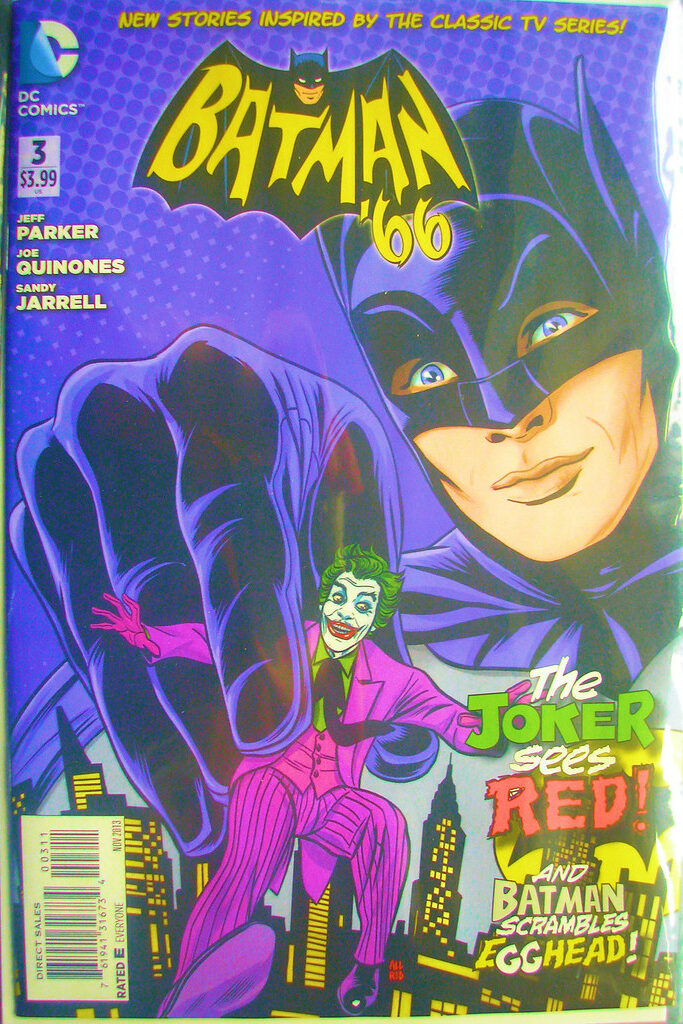
- Marvel rivalry, TV era, and design. DC’s Justice League helped inspire Marvel’s own team‑based strategy. The 1966 Batman TV series led to a tonal pivot and the (short‑lived) “Go‑Go Checks” cover dress. Artist Carmine Infantino rose to editorial leadership in 1967, courting talents like Neal Adams and Denny O’Neil.
- Corporate changes. DC’s parentage shifted: NPP acquired by Kinney National (1967), which later became Warner Communications after acquiring Warner Bros.-Seven Arts (1969).
Bronze Age (1970–mid‑1980s)
- Topical storytelling. Notable arcs tackled social issues—e.g., Green Lantern/Green Arrow’s exploration of drug addiction and social justice.
- Kirby’s Fourth World. Jack Kirby launched New Gods, Mister Miracle, and The Forever People, adding Darkseid and Apokolips—mythic pillars of the DCU—even as some series were short‑lived initially.
- Kahn era, royalties & the mini‑series. Jenette Kahn (publisher, 1976) modernized business practices, introduced creator royalties, and popularized the limited series (e.g., World of Krypton, later Camelot 3000). The New Teen Titans (1980) revitalized team books.
- Continuity reset. Crisis on Infinite Earths (1985–86) streamlined the DCU; The History of the DC Universe codified the post‑Crisis timeline.
Modern to Contemporary (late‑1980s–Present)
- Prestige, Vertigo, and graphic novels. Seminal works—Batman: The Dark Knight Returns, Watchmen—drew mainstream attention. Vertigo (1993) nurtured mature readers’ titles and British‑Invasion voices.
- Imprints & acquisitions. 1990s–2000s saw Piranha Press, Paradox/Helix, Impact, Milestone, WildStorm (plus ABC line), CMX manga, and archival projects. DC licensed Elfquest and Spirit material at times.
- Line initiatives. All‑Star line (mid‑2000s); First Wave (2010–11) with pulp icons; digital day‑and‑date (2011). Universe‑wide resets and refreshes: The New 52 (2011), Rebirth (2016), Infinite Frontier (2021), Dawn of DC (2023).
- Events & operations. Convergence (2015); DC2/DC2 Multiverse digital experiments; relocates HQ to Burbank (2015). DC FanDome virtual events debuted in 2020. Executive changes included 2020 leadership shifts; in 2023, Jim Lee was named President of DC in addition to Publisher & CCO.
Logos (Evolution)
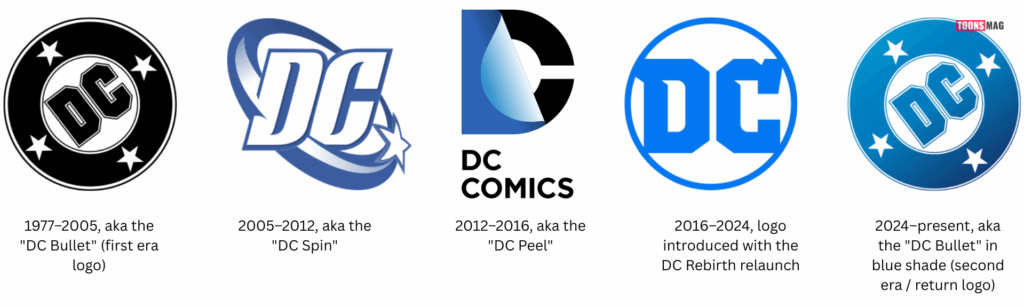
- 1941 update — “A DC Publication” with Superman reference; the logo moves to the top‑left corner of covers.
- 1977 “DC Bullet” — Designed by Milton Glaser under publisher Jenette Kahn; a long‑running, iconic mark.
- 2005 “DC Spin” — A modernized dynamic emblem used across comics and media.
- 2012 “DC Peel” — A fold‑back “D” revealing “C,” meant to evoke dual identities.
- 2016 Rebirth logo — Circle‑framed classicist wordmark.
- 2024 — Updated “DC Bullet” returns (blue shade), unveiled at San Diego Comic‑Con with a new DC Studios intro.
Imprints & Lines
Active
- DC (1937–present)
- Elseworlds (1989–2010; 2024–present)
- Vertigo (1993–2020; 2024–present)
- Sandman Universe (2018–present)
- WildStorm (1999–2010; 2017–present)
- Earth‑M / Milestone (1993–1997; 2018–present)
- DC Black Label (2018–present)
- Hill House Comics (2019–present)
- DC Graphic Novels for Young Adults (2020–present)
- DC Graphic Novels for Kids (2020–present)
- DC Horror (2021–present)
- DC Compact Comics (2024–present)
- MAD (1953–present)
Retired / Defunct (Selected)
- DC Archive Editions (1989–2014; replaced by DC Omnibus)
- Piranha Press (1989–1993; became Paradox Press)
- Impact Comics (1991–1993; Archie license)
- Amalgam Comics (1996–1997; with Marvel)
- Helix (1996–1998; folded into Vertigo)
- Tangent Comics (1997–1998)
- Paradox Press (1998–2003)
- WildStorm Productions (1999–2010)
- America’s Best Comics (1999–2005)
- Homage / Cliffhanger / WildStorm Signature (1999–2006)
- CMX Manga (2004–2010)
- DC Focus (2004–2005)
- Johnny DC (2004–2012)
- All‑Star (2005–2008)
- Minx (2007–2008)
- Zuda Comics (2007–2010)
- First Wave (2010–2011)
- Young Animal (2016–2021)
- DC Ink / DC Zoom (2019; evolved into GN lines for YA/Kids)
- Wonder Comics (2019–2021)
Distribution & Business
- Direct market: Lunar Distribution
- Book trade: Penguin Random House Publisher Services
- Licensing: extensive cross‑media and consumer products programs via Warner Bros. Discovery divisions.
Key People (Past & Present — Selected)
- Founders/Builders: Malcolm Wheeler‑Nicholson, Harry Donenfeld, Jack S. Liebowitz, Max Gaines
- Editorial leaders: Julius Schwartz, Carmine Infantino, Jenette Kahn, Paul Levitz, Dick Giordano
- Modern leadership: Jim Lee (President, Publisher, CCO), Anne DePies (SVP, GM), Marie Javins (Editor‑in‑Chief)
Notable Media & Cultural Impact
- Superhero archetypes and modern comic storytelling codified through Superman, Batman, Wonder Woman.
- Multimedia: film/TV animation and live‑action (e.g., Batman, Superman, DC Extended Universe, DC Studios initiatives), games, streaming.
- Fandom & conventions: DC’s characters are staples at major cons; the company’s awards heritage intersects with industry accolades (Eisner, Harvey, Inkpot).
FAQs about DC Comics
What does “DC” stand for?
Detective Comics, the long‑running anthology launched in 1937.
Is everything DC publishes in continuity?
No. Many books are stand‑alone, alternate‑universe (Elseworlds) or mature‑readers (Black Label); classic non‑DCU works appeared under Vertigo.
Who distributes DC comics today?
Lunar Distribution (direct market) and Penguin Random House Publisher Services (bookstores and mass retail).
When did DC move to Burbank?
2015, consolidating operations with other Warner Bros. divisions.
What are recent line‑wide initiatives?
The New 52 (2011), Rebirth (2016), Infinite Frontier (2021), and Dawn of DC (2023).



One Comment