

 Anto Mario

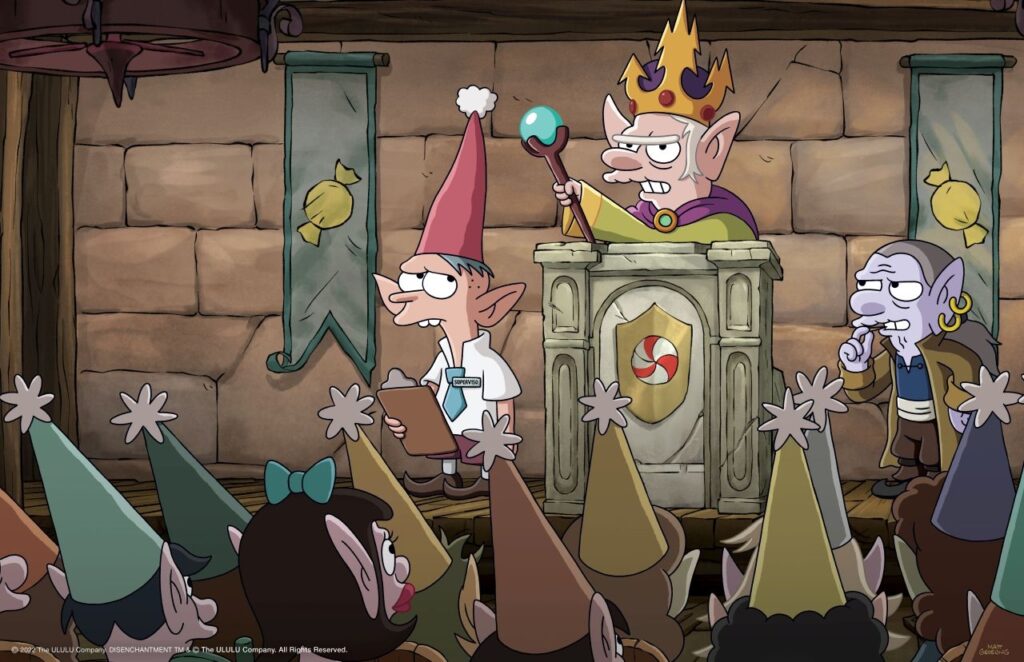
Disenchantment is an American adult animated fantasy sitcom created by Matt Groening for Netflix. The series premiered on August 17, 2018, and concluded on September 1, 2023, after five parts comprising 50 episodes. Animated by Rough Draft Studios, Disenchantment represents Groening’s first original animated series developed exclusively for a streaming platform, following his long-running network television successes The Simpsons (1989–present) and Futurama (1999–2013).
Set primarily in the medieval fantasy kingdom of Dreamland, the series blends elements of fantasy, political satire, dark comedy, and serialized storytelling. It centers on Princess Tiabeanie Mariabeanie de la Rochambeau Grunkwitz, commonly known as Bean, alongside her companions Luci, a personal demon, and Elfo, a half-elf from the secluded land of Elfwood. Over its five-part run, Disenchantment explores themes of governance, destiny, gender roles, morality, mental health, and the tension between tradition and progress.
Disenchantment
- Genre: Animated Fantasy Sitcom
- Created by: Matt Groening
- Streaming Service: Netflix
- Number of Episodes: 50 (5 parts)
- First Part Release: August 2018
- Final Part Release: September 1, 2023
Main Characters:
- Bean (Princess Tiabeanie Mariabeanie de la Rochambeau Grunkwitz) – Voiced by Abbi Jacobson
- Luci (Bean’s personal demon) – Voiced by Eric André
- Elfo (Half-elf) – Voiced by Nat Faxon
- King Zøg (Bean’s father and ruler) – Voiced by John DiMaggio
- Queen Oona (King Zøg’s second wife) – Voiced by Tress MacNeille
- Prince Derek (Zøg and Oona’s hybrid son)
- Prince Merkimer (Arranged to marry Bean) – Voiced by Matt Berry
- Odval (Prime Minister of Dreamland) – Voiced by Maurice LaMarche
- Queen Dagmar (Bean’s mother and sorceress) – Voiced by Sharon Horgan
Development: Created by Matt Groening, animated by Rough Draft Studios.
Casting: Main cast includes Abbi Jacobson, Eric André, Nat Faxon, John DiMaggio, Tress MacNeille, Matt Berry, David Herman, Maurice LaMarche, Lucy Montgomery, and Billy West.
Reception: The series received generally positive reviews with praise for its humor and character development.
Background and Context
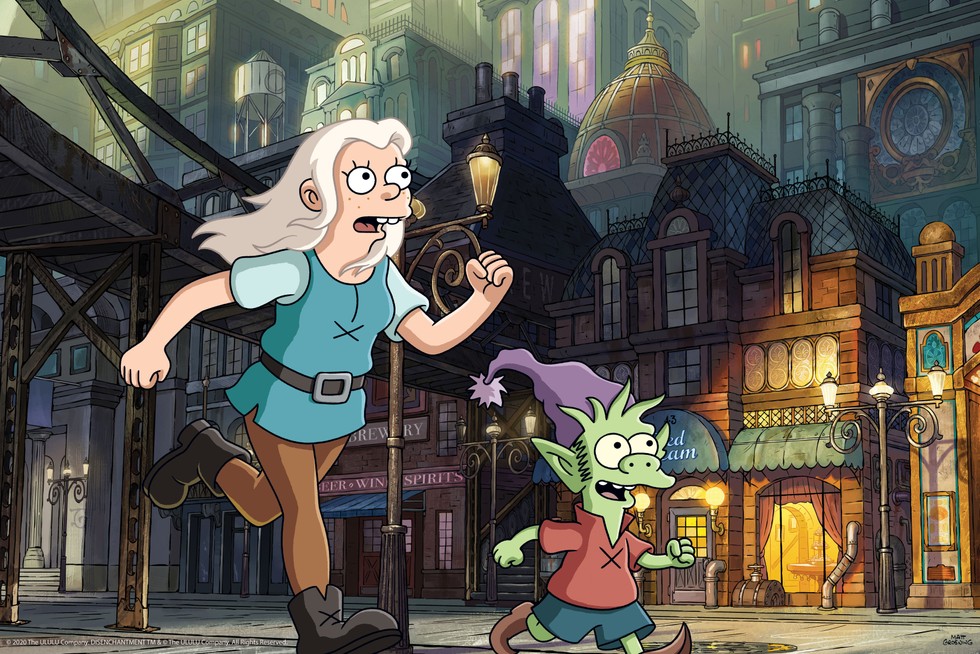
Matt Groening’s Career Prior to Disenchantment
Before Disenchantment, Matt Groening had established himself as one of the most influential figures in American animation. The Simpsons revolutionized prime-time animated television by combining satire, family comedy, and cultural commentary, becoming the longest-running scripted television series in U.S. history. Futurama further expanded Groening’s reputation by integrating science fiction, serialized storytelling, and emotional continuity into adult animation.
Disenchantment emerged during a period of transformation in television distribution, as streaming platforms increasingly favored serialized narratives and long-form character development. Netflix’s commissioning of the series allowed Groening to depart from traditional episodic constraints and experiment with extended narrative arcs.
Premise
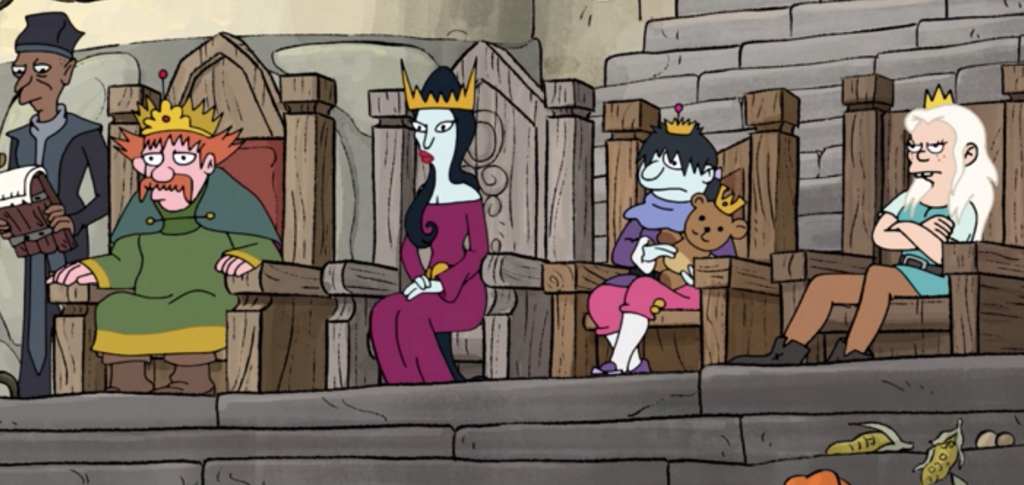
Disenchantment is set in a fictional medieval fantasy world populated by humans, elves, demons, ogres, mermaids, and other mythical beings. The primary setting, Dreamland, is a hereditary monarchy ruled initially by King Zøg, whose governance is characterized by instability, impulsive decision-making, and reliance on tradition rather than competence.
The narrative follows Princess Bean, a young royal who resists expectations of marriage, obedience, and decorum. She is accompanied by Luci, a demon assigned to corrupt her, and Elfo, a half-elf whose optimism contrasts with Dreamland’s cynicism. As the series progresses, the trio becomes entangled in political conspiracies, ancient magical conflicts, and existential questions concerning power, morality, and identity.
Unlike Groening’s earlier series, Disenchantment relies heavily on serialized storytelling, with plotlines unfolding gradually across multiple episodes and seasons rather than resetting at the end of each installment.
Creation and Development
Conceptualization
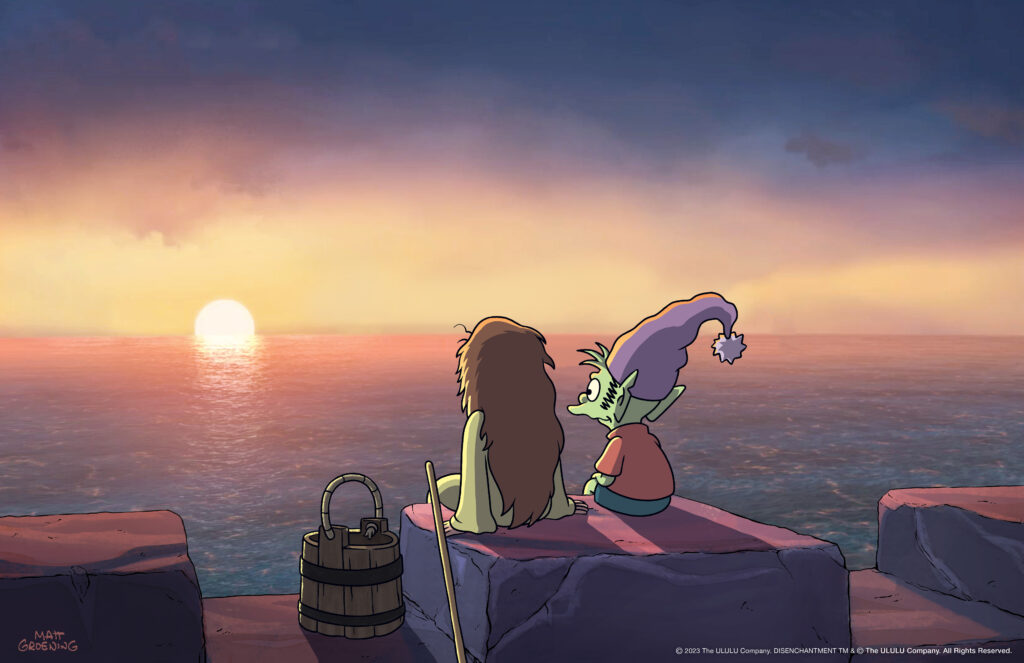
Groening conceived Disenchantment as a fantasy counterpart to his earlier contemporary and futuristic works. By situating the series in a medieval setting, Groening and his collaborators sought to examine timeless social and political structures—monarchy, inheritance, class hierarchy—through satire and allegory.
The series was co-developed with Josh Weinstein and Bill Oakley, both veteran writers and producers from The Simpsons. Their involvement helped maintain continuity with Groening’s established comedic sensibilities while supporting a more serialized narrative structure.
Production
Animation was produced by Rough Draft Studios, which had previously animated Futurama. Character designs adhere to Groening’s signature aesthetic, featuring simplified forms, expressive eyes, and exaggerated facial structures. Background art emphasizes medieval architecture, fantasy landscapes, and anachronistic visual humor.
Netflix initially ordered 20 episodes, later expanding the order to 50. The series was released in five parts, each consisting of ten episodes.
Characters
At the heart of Disenchantment lies a deliberately unconventional ensemble. Rather than presenting clear heroes and villains, the series constructs characters defined by contradiction, emotional volatility, and gradual transformation. This approach aligns with the show’s broader rejection of simplistic fantasy archetypes and sitcom reset logic.
Main Characters
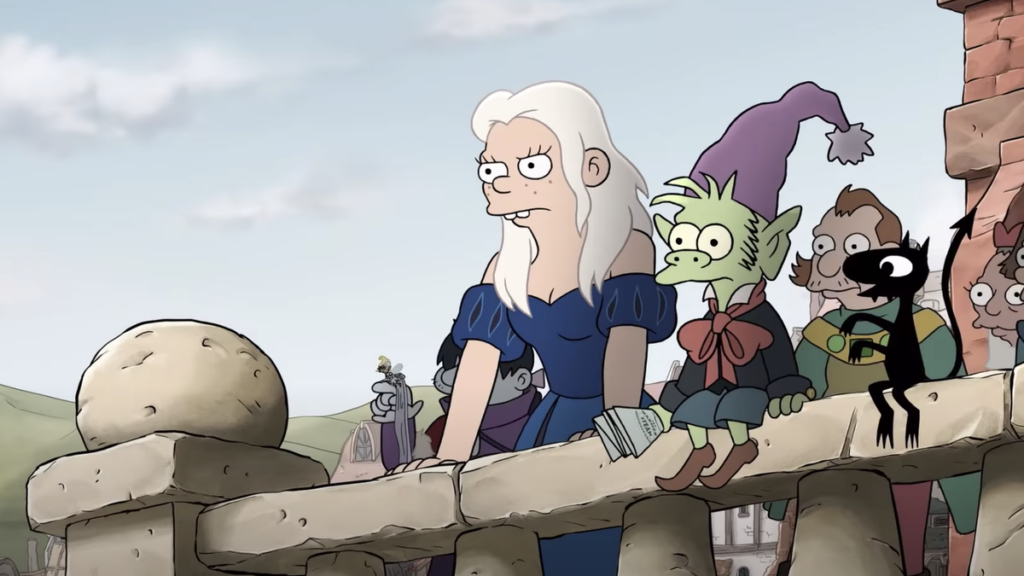
Princess Tiabeanie Mariabeanie de la Rochambeau Grunkwitz (Bean)
Voiced by Abbi Jacobson, Princess Bean is the narrative and emotional core of Disenchantment. From her first appearance, Bean is framed as a rejection of traditional princess mythology. She drinks heavily, swears freely, avoids courtly etiquette, and actively resists expectations placed upon her as a royal woman.
However, Bean is not merely a parody of the princess trope. Her rebellion masks deeper struggles with:
- Emotional neglect
- Parental betrayal
- Fear of inadequacy
- Anxiety over inherited power
Over the course of the series, Bean’s arc evolves from cynical avoidance to reluctant engagement with responsibility. She does not seek leadership, yet circumstances repeatedly force her into positions of authority. This tension forms one of the show’s central conflicts: can power be wielded ethically by someone who distrusts power itself?
Bean’s discovery of her inherited magical abilities complicates this question further. Magic in Disenchantment is not a gift but a burden—tied to lineage, trauma, and historical violence. Bean’s struggle is therefore not about mastering magic, but about choosing what kind of ruler, daughter, and individual she wishes to become.
Her arc explores autonomy, moral agency, and the cost of self-awareness, positioning her as one of the more psychologically complex protagonists in adult animated fantasy.
Luci
Voiced by Eric André, Luci begins the series as a classic fantasy archetype: a personal demon sent to corrupt the hero. Yet Disenchantment quickly subverts this role. Rather than driving Bean toward evil, Luci becomes her most consistent companion and emotional mirror.
Luci represents:
- Nihilism
- Hedonism
- Cynicism toward moral absolutes
Initially, he encourages Bean’s worst impulses—violence, selfishness, apathy. However, as the series progresses, Luci develops unexpected emotional depth. He demonstrates loyalty, guilt, jealousy, and even self-sacrifice, complicating the notion of what a “demon” is meant to represent.
His relationship with Bean challenges binary moral frameworks. Luci is not redeemed in a traditional sense, nor does he fully abandon his demonic nature. Instead, he occupies a morally ambiguous space where care and corruption coexist. This ambiguity allows Disenchantment to explore ethics as relational rather than ideological.
Luci’s eventual confrontations with Hell and divine authority further underscore the series’ skepticism toward rigid moral hierarchies.
Elfo
Voiced by Nat Faxon, Elfo is a half-elf raised in the artificially cheerful land of Elfwood—a place defined by enforced happiness, denial of complexity, and cultural homogeneity. Elfo’s decision to leave Elfwood initiates one of the series’ most emotionally grounded arcs.
Elfo embodies:
- Idealism
- Empathy
- A desire for belonging
Unlike Bean’s cynicism or Luci’s nihilism, Elfo genuinely believes in goodness and fairness. This makes him uniquely vulnerable in the brutal, absurd world of Dreamland. His arc repeatedly confronts the cost of optimism in systems that reward cruelty or indifference.
Elfo’s mixed heritage—half-elf, half-ogre—serves as a metaphor for identity fragmentation. He belongs fully to neither world, a condition that shapes his emotional insecurity and longing for acceptance. His willingness to sacrifice himself for others highlights a recurring theme: kindness as an act of resistance rather than naivety.
Through Elfo, Disenchantment interrogates whether goodness can survive without becoming self-destructive.
Supporting Characters
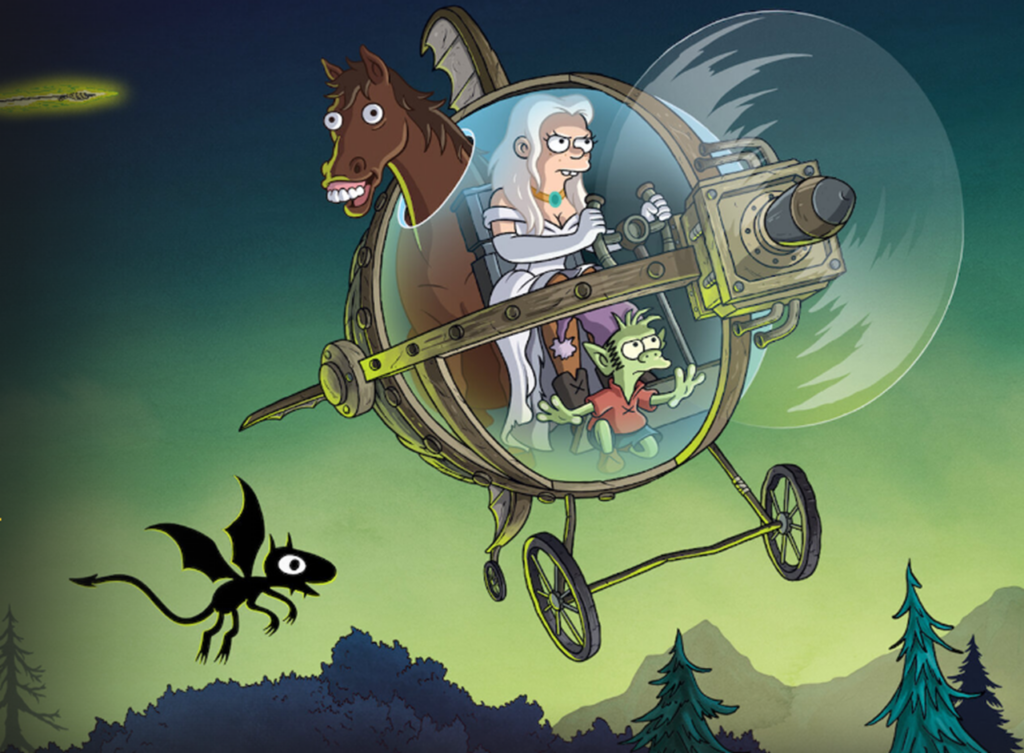
King Zøg (voiced by John DiMaggio)
King Zøg, ruler of Dreamland and Bean’s father, is initially portrayed as a loud, impulsive tyrant driven by ego and tradition. Over time, his characterization deepens into one of the show’s most unsettling arcs.
Zøg’s reign is marked by:
- Authoritarian instincts
- Emotional incompetence
- Fear of irrelevance
As his political power erodes, Zøg experiences a gradual psychological breakdown. His mental deterioration—depicted through paranoia, delusions, and emotional regression—stands out as one of the more sustained portrayals of mental illness in adult animation.
Importantly, the series does not frame Zøg’s illness as a joke, even when comedic elements remain. His decline reflects the human cost of unchecked power and emotional repression, complicating his role as both antagonist and tragic figure.
Queen Dagmar (voiced by Sharon Horgan)
Queen Dagmar, Bean’s mother, is one of the series’ primary antagonists and its most potent symbol of inherited corruption. Elegant, manipulative, and ruthless, Dagmar represents power stripped of empathy.
Her maternal relationship with Bean is deeply fraught. Dagmar weaponizes affection, using intimacy as a tool of control. Her magic is tied to domination rather than creation, reinforcing the series’ association of power with moral compromise.
Dagmar’s presence underscores one of Disenchantment’s central questions: is evil a personal choice, or a legacy passed down through systems and bloodlines?
Queen Oona (voiced by Tress MacNeille)
Initially introduced as a comic outsider—an amphibian noble from Dankmire—Queen Oona undergoes one of the series’ most surprising transformations. Once dismissed as eccentric and incompetent, Oona evolves into a politically astute, self-possessed leader.
Her arc reframes her as:
- Adaptable
- Strategically intelligent
- Emotionally resilient
Oona’s journey challenges assumptions about foreignness, femininity, and leadership competence, making her one of the show’s most quietly subversive characters.
Prince Derek
Prince Derek, the son of Zøg and Oona, functions as both satire and commentary on inherited power. Naive, easily manipulated, and unprepared for leadership, Derek embodies the dangers of hereditary rule divorced from capability.
Prince Merkimer (voiced by Matt Berry)
Prince Merkimer is a narcissistic aristocrat transformed into a pig—a fate that literalizes his moral state. His arc satirizes vanity, entitlement, and the illusion of superiority.
Despite moments of self-awareness, Merkimer largely remains trapped by ego, serving as a critique of aristocratic self-absorption.
Odval (voiced by Maurice LaMarche)
Odval, the three-eyed prime minister of Dreamland, represents bureaucratic manipulation and shadow governance. Unlike overt tyrants, Odval wields power subtly—through alliances, secrets, and procedural authority.
He embodies the series’ critique of political systems that operate beyond accountability.
Narrative Structure
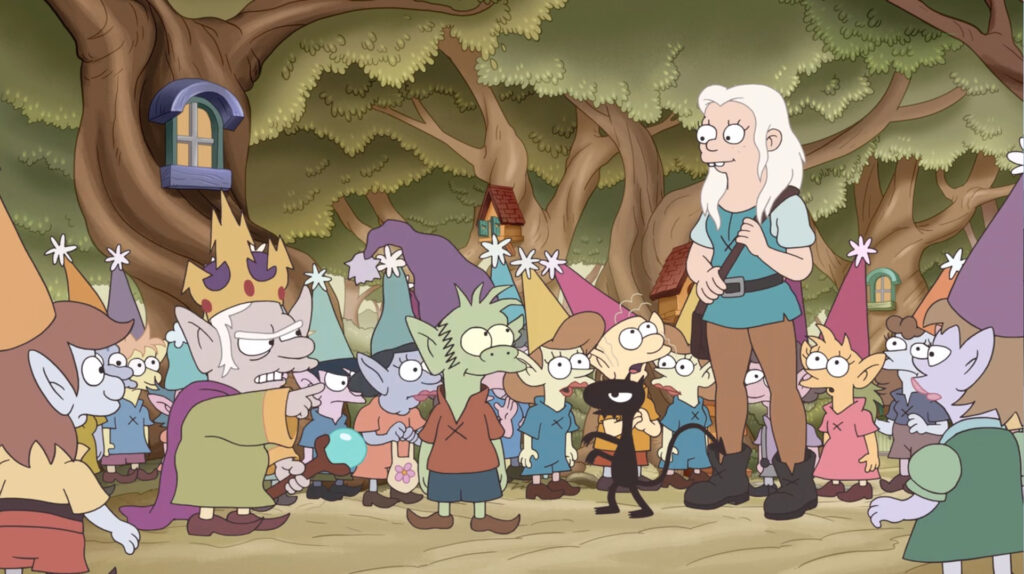
Part-Based Organization and Serialized Storytelling
Disenchantment is structured into five serialized parts rather than episodic seasons. This format emphasizes long-term narrative accumulation, a departure from Matt Groening’s earlier reset-driven series.
- Part 1 (2018): Establishes Dreamland, core relationships, and thematic foundations.
- Part 2 (2019): Deepens political intrigue and magical mythology.
- Part 3 (2021): Introduces Steamland, contrasting magic with technology.
- Part 4 (2022): Explores consequences of power shifts and supernatural bargains.
- Part 5 (2023): Resolves major arcs while embracing moral ambiguity.
This structure prioritizes continuity over immediate payoff, rewarding attentive viewing.
Themes and Analysis
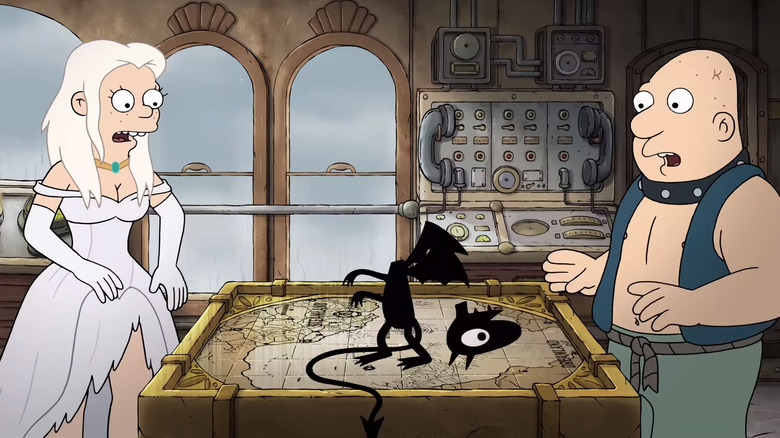
Power and Governance
Disenchantment presents monarchy as an inherently unstable system—one sustained by myth rather than merit. Authority is inherited, not earned, and its failures are systemic rather than individual.
Gender and Autonomy
Bean’s resistance to marriage, passivity, and maternal expectations aligns with feminist critiques of fantasy narratives. Her autonomy is not framed as exceptional—it is contested, fragile, and costly.
Morality and Identity
The series rejects moral binaries. Characters such as Luci and Dagmar illustrate that ethics are shaped by context, relationships, and power dynamics rather than absolute categories.
Mental Health
King Zøg’s psychological decline is portrayed as cumulative and relational, reflecting trauma, isolation, and the emotional toll of leadership. This sustained depiction distinguishes Disenchantment from more superficial treatments of mental illness in animation.
Reception
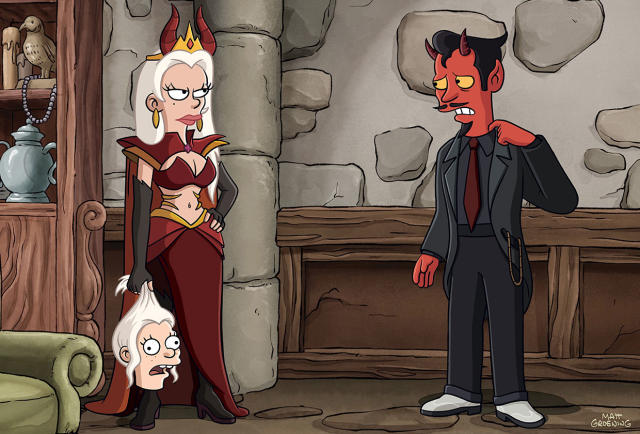
Critical Reception
Early reviews criticized pacing and tonal inconsistency. However, later parts received more favorable reassessment as narrative cohesion and thematic ambition became clearer.
Audience Response
Audience appreciation evolved over time, with many viewers recognizing Disenchantment retrospectively as a series better suited to binge-watching and long-form analysis.
Connections to Other Works
Disenchantment includes explicit references to Futurama and The Simpsons, most notably the appearance of the Planet Express time machine. These moments suggest a shared multiverse while reinforcing Groening’s recurring themes: institutional failure, flawed protagonists, and existential humor.
Legacy
Disenchantment occupies a transitional position in adult animation history. It reflects the industry’s shift toward:
- Streaming-first distribution
- Serialized storytelling
- Genre hybridity
While it did not achieve the cultural ubiquity of Groening’s earlier series, it expanded the narrative vocabulary of adult animated fantasy.
Disenchantment represents a significant evolution in Matt Groening’s creative trajectory. Through its serialized structure, morally complex characters, and fantasy framework, the series explored power, identity, and governance with unusual depth for adult animation.
Though its reception was mixed, Disenchantment remains an important example of the medium’s capacity for long-form storytelling and thematic experimentation—one that rewards patience, attention, and critical engagement.
FAQ: Disenchantment – Matt Groening’s Animated Fantasy Sitcom
1. What is Disenchantment?
Disenchantment is an American animated fantasy sitcom created by Matt Groening for Netflix. It’s set in the medieval fantasy kingdom of Dreamland and follows the adventures of Princess Bean, her demon Luci, and their elf companion Elfo.
2. Who is the creator of Disenchantment?
Matt Groening, the creator of The Simpsons and Futurama, is the mastermind behind Disenchantment.
3. Where can I watch Disenchantment?
Disenchantment is exclusively available on Netflix.
4. How many episodes and seasons are there?
Disenchantment consists of five parts, each containing ten episodes. The first part premiered in August 2018, and the fifth and final part was released on September 1, 2023.
5. Who are the main characters in Disenchantment?
- The main characters include:
- Princess Bean (Abbi Jacobson)
- Luci (Eric André)
- Elfo (Nat Faxon)
- King Zøg (John DiMaggio)
- Queen Oona (Tress MacNeille)
- Prince Derek (Tress MacNeille)
- Prince Merkimer (Matt Berry)
- Odval (Maurice LaMarche)
- Queen Dagmar (Sharon Horgan)
6. Can you tell me more about the plot?
Disenchantment is set in the fictional kingdom of Dreamland and follows the rebellious Princess Bean, her demon Luci, and her elf companion Elfo. Over five parts, they embark on adventures, uncover mysteries, and encounter mythical elements.
While Disenchantment has its unique world and characters, it bears Matt Groening’s trademark humor and animation style. Some crossovers or references to other Groening series may exist.
8. Are there plans for more episodes or seasons?
The creators have confirmed that new episodes were in production as of September 2022. However, as of August 1, 2023, Netflix announced that Disenchantment would conclude with the fifth and final part.
9. What can I expect from the humor and themes in Disenchantment?
Disenchantment combines humor with fantastical elements and often tackles themes such as feminism, adventure, and mythology. It’s known for its witty writing and unique character dynamics.
10. What is the critical reception of Disenchantment?
Disenchantment received mixed-to-positive reviews, with some praising its humor and character development, while others found it slow to start. It has a dedicated fan base is known for its charm and uniqueness.
Read also: Matt Groening (1954-): The Creative Genius Behind The Simpsons, Futurama, and Disenchantment, The Simpsons: A Chronicle of American Satire, and Futurama: The Time-Traveling Odyssey of Matt Groening
This post was created with our nice and easy submission form. Create your post!







One Comment