

 Liam Morris

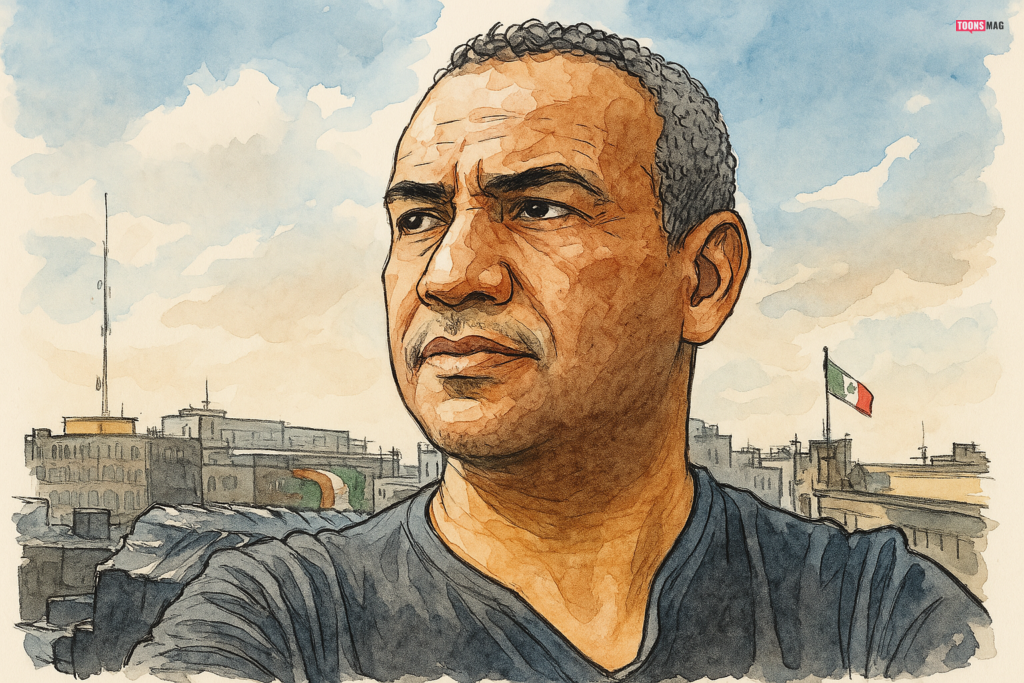
Emad Hajjaj (Arabic: عماد حجاج; born 1967) is a Palestinian-Jordanian editorial cartoonist whose sharp humor, political insight, and fearless social commentary have made him one of the most influential voices in the Middle East. Best known for creating the beloved Jordanian character Abu Mahjoob, Hajjaj’s cartoons have appeared in leading newspapers such as Al Ra’i and The Jordan Times, captivating audiences across the Arab world.
Through wit and satire, Hajjaj has built a legacy of challenging authority, exposing hypocrisy, and giving voice to the struggles of ordinary citizens — often at great personal risk.
Emad Hajjaj — Infobox
| Full Name | Emad Hajjaj (Arabic: عماد حجاج) |
|---|---|
| Born | 1967 — West Bank, Jordan (now Palestinian Territories) |
| Nationality | Jordanian / Palestinian |
| Occupation | Editorial Cartoonist, Political Satirist, Illustrator |
| Years Active | 1993 – present |
| Education | Bachelor of Fine Arts, Yarmouk University, Jordan (1991) — Major: Graphic Design, Minor: Journalism |
| Known For | Political and social satire; creation of Abu Mahjoob character |
| Notable Publications | Al Ra’i, The Jordan Times |
| Famous Character | Abu Mahjoob (أبو محجوب) — a symbol of the everyday Jordanian, reflecting social and political realities |
| Family | Brother: Osama Hajjaj, also a cartoonist |
| Major Themes | Corruption, extremism, human rights, women’s issues, social justice, Arab identity |
| Arrest and Advocacy | Arrested in 2020 under Jordan’s Cybercrime Law for a cartoon criticizing the Israel–UAE peace agreement; released on bail after four days |
| Awards and Exhibitions | • Lighting Lamps exhibition (British Council) contributor • Solo exhibition, Ra’s al-‘Ayn City Hall (2008) – 100 works displayed • Featured in multiple Middle Eastern and international art shows |
| Style / Medium | Editorial and political cartoons, caricature, digital and print illustration |
| Residence | Amman, Jordan |
| Languages | Arabic (native), English |
Early Life and Education
Emad Hajjaj was born in 1967 in the West Bank, then under Jordanian rule. Growing up amid regional political upheaval, he witnessed firsthand the tensions of identity, power, and freedom that would later become central themes in his work.
He pursued his artistic education at Yarmouk University in Irbid, Jordan, where he graduated in 1991 with a Bachelor of Fine Arts degree, majoring in graphic design and minoring in journalism. This blend of design skill and journalistic awareness shaped the foundation of his career as a visual storyteller.
Career and Artistic Vision
Early Work and Style
Hajjaj began his professional career in the early 1990s, contributing cartoons to major Jordanian newspapers including Al Ra’i and The Jordan Times. His works quickly gained recognition for their unique combination of humor, empathy, and political courage.
His drawings are known for their simple yet powerful linework and for addressing sensitive topics — corruption, inequality, extremism, and cultural contradictions — in ways that resonate with the Arab public.
Collaboration and Family
Emad’s younger brother, Osama Hajjaj, is also a noted Jordanian political cartoonist. Together, the Hajjaj brothers have become two of the most prominent satirical artists in the Arab world.
Both brothers have faced death threats and intimidation for their critical cartoons, particularly those targeting ISIS and other extremist groups. Despite these risks, they continue to use satire as a means of truth-telling and resistance.
Notable Work: The Abu Mahjoob Character
Perhaps Emad Hajjaj’s greatest cultural contribution is the creation of Abu Mahjoob (أبو محجوب) — one of the most recognizable figures in Arab satire.
He first drew Abu Mahjoob in 1993 as a character hanging posters during Jordan’s parliamentary elections. The figure quickly evolved into a symbol of the common Jordanian citizen, embodying the frustrations, humor, and resilience of everyday life.
“Abu Mahjoob is the voice of the street,” Hajjaj once said. “He speaks for those who can’t.”
Abu Mahjoob wears a pinstripe suit and necktie under a red keffiyeh and agal, sporting a crooked mustache — a mixture of modernity and tradition. The character’s wit and irony were inspired by Hajjaj’s own father, whose humor he described as “the kind that turns pain into laughter.”
Over the decades, Abu Mahjoob has appeared in print, animation, and digital media, becoming a cultural icon in Jordan and a touchstone for Arab political satire.

Social Commentary and Controversy
Hajjaj’s art often confronts difficult social and political realities head-on.
During the Pan Arab Games held in Amman, he published a widely discussed cartoon criticizing the contradiction of national pride while honor killings persisted. The piece sparked heated debates across Jordanian society and cemented his reputation as an artist unafraid to challenge moral complacency.
In 2008, a retrospective exhibition titled “100 Cartoons by Emad Hajjaj” was held at the Ra’s al-‘Ayn City Hall, showcasing the breadth of his satirical vision. The same year, he contributed to Lighting Lamps, an exhibition sponsored by the British Council, which promoted dialogue through art.
Arrest and Press Freedom
On 26 August 2020, Emad Hajjaj was arrested in Jordan under the country’s Cybercrime Law after publishing a cartoon that criticized the Israel–United Arab Emirates peace agreement.
The controversial drawing portrayed Crown Prince Mohammed bin Zayed of Abu Dhabi holding a white dove painted with the Israeli flag — the bird spits on his face, and the caption reads:
“Israel asks the USA not to sell F-35 warplanes to the UAE.”
The spit spelled out “Spit-35,” a wordplay on the F-35 fighter jet deal.
The cartoon went viral across social media, sparking debate on freedom of expression in Jordan and the Arab world. Several journalist and human rights organizations called for his immediate release, emphasizing that satire should not be criminalized.
Hajjaj was released four days later, after the Jordanian Journalists Syndicate posted bail. His arrest underscored the ongoing risks faced by Arab artists who use humor to critique political power.

Artistic Legacy and Global Recognition
Emad Hajjaj’s cartoons have been featured in exhibitions around the world and translated into multiple languages. His works capture the complexity of Arab society — balancing pain with laughter, criticism with empathy, and tradition with change.
Over the years, Hajjaj’s art has received international acclaim for its courage, humanity, and visual simplicity. His character Abu Mahjoob continues to serve as a mirror for Jordanian society — a reminder that satire remains one of the last free spaces for truth in the Arab world.
Through his humor, he tackles not only political corruption but also social taboos such as gender inequality, extremism, and media censorship.

Personal Life
Emad Hajjaj lives and works in Amman, Jordan, where he continues to publish cartoons online and in print. He often collaborates with his brother Osama Hajjaj, and together they advocate for press freedom and artists’ rights in the region.
When asked why he keeps drawing despite the risks, Hajjaj once said:
“Cartoons are my weapon — they don’t kill, but they awaken.”
Legacy of Abu Mahjoob
The enduring popularity of Abu Mahjoob lies in his relatability. He is at once a social critic, a family man, and an everyman — sarcastic, insightful, and unapologetically Jordanian.
Through Abu Mahjoob, Hajjaj has achieved something rare: creating a national cartoon icon that transcends borders, languages, and generations


One Comment