

 Anto Mario

The Feminist Cartooning of Alison Bechdel: Cartooning has long been misunderstood as a lightweight or purely humorous art form. Yet throughout the 20th and 21st centuries, cartoonists have repeatedly demonstrated that drawings—especially when paired with words—can confront the most complex questions of identity, politics, memory, and power. Few artists embody this potential as profoundly as Alison Bechdel.
Bechdel is not simply a successful cartoonist or graphic memoirist; she is a cultural architect whose work reshaped how comics are understood, taught, and valued. Her influence reaches far beyond the page, affecting feminist theory, LGBTQ+ representation, literary studies, theater, and even mainstream film discourse through the now-ubiquitous Bechdel Test.
At the heart of Bechdel’s feminist cartooning lies a deceptively simple conviction: the personal is not only political—it is analytical. Through meticulous visual composition, literary allusion, and emotional honesty, Bechdel has shown that comics can function as autobiography, criticism, philosophy, and social history simultaneously.
This article explores Alison Bechdel’s feminist cartooning in depth, with particular focus on Fun Home: A Family Tragicomic (2006), while situating that work within her broader career and cultural impact.
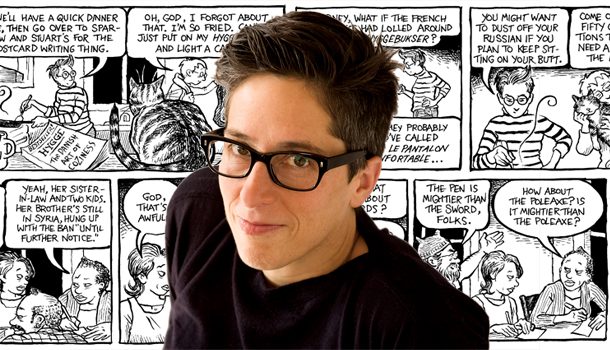
Alison Bechdel: Early Life, Education, and Intellectual Formation
Childhood and Family Context
Alison Bechdel was born on September 10, 1960, in Lock Haven, Pennsylvania, and raised in the nearby town of Beech Creek. Her upbringing was shaped by a family environment steeped in literature, performance, repression, and contradiction—elements that would later become central to her work.
Her father, Bruce Bechdel, was:
- A high school English teacher
- A funeral home director
- A closeted gay man living in a conservative rural community
Her mother, Helen Bechdel, was:
- A high school English teacher
- A frustrated actress and intellectual
- Emotionally distant but verbally incisive
Books, theater, and aesthetic perfection filled the Bechdel household, yet emotional openness did not. This tension—between intellectual abundance and emotional scarcity—became a recurring subject in Bechdel’s work.
Education and Feminist Awakening
Bechdel attended Oberlin College, a liberal arts institution known for its progressive politics and strong feminist culture. There, she encountered:
- Second-wave feminism
- Lesbian separatist theory
- Queer activism
- Experimental art and literature
Oberlin was not merely an academic environment for Bechdel—it was a site of self-recognition. She came out as a lesbian during her college years, an experience that would permanently shape her artistic voice.
“Dykes to Watch Out For”: Feminism as Community Narrative
Origins and Scope
Bechdel first gained widespread recognition through her long-running comic strip Dykes to Watch Out For (DTWOF), which ran from 1983 to 2008. Initially conceived as a series of political cartoons, DTWOF evolved into a richly serialized narrative chronicling the lives of a diverse group of lesbian characters over decades.
Feminist Significance
DTWOF was revolutionary because it:
- Centered lesbian lives without apology
- Treated queer women as politically engaged citizens
- Addressed feminism, racism, class, capitalism, and environmentalism
- Refused respectability politics
The strip functioned as an alternative historical record of feminist and LGBTQ+ life from the Reagan era through the early 21st century.
The Bechdel Test
Ironically, Bechdel’s most famous contribution to popular culture—the Bechdel Test—emerged almost casually from DTWOF. Introduced in a 1985 strip, the test asks whether a film:
- Has at least two women
- Who talk to each other
- About something other than a man
Though intended humorously, the test became a widely used tool in film criticism and gender studies, underscoring Bechdel’s talent for condensing structural critique into accessible form.
“Fun Home”: Feminist Autobiography as Graphic Literature
Publication and Reception
Published in 2006, Fun Home: A Family Tragicomic marked a turning point not only in Bechdel’s career but in the status of graphic memoir as a literary form.
The book received:
- Widespread critical acclaim
- Multiple awards, including an Eisner Award
- Inclusion in university syllabi worldwide
- Adaptation into a Tony Award–winning Broadway musical
Yet Fun Home is not merely notable for its success—it is remarkable for its formal ambition and emotional precision.
Feminist Themes in Fun Home
Sexuality and Self-Recognition
At its core, Fun Home is a coming-out narrative—but one that refuses simplicity. Bechdel juxtaposes her own gradual realization of her lesbian identity with her father’s lifelong repression of his homosexuality.
From a feminist perspective, this dual narrative exposes:
- Gendered expectations around desire
- The cost of compulsory heterosexuality
- The asymmetry between male and female sexual freedom
Bechdel does not frame her sexuality as tragedy or triumph but as epistemology—a way of knowing herself and the world.
Family, Patriarchy, and Emotional Labor
The memoir’s exploration of family dynamics is deeply feminist in its attention to emotional labor, silence, and power.
Bruce Bechdel’s authority is aesthetic rather than emotional:
- He controls the home’s appearance
- He curates literature and décor
- He polices behavior
Helen Bechdel, meanwhile, bears the emotional weight of the family while receiving little recognition or fulfillment.
Bechdel’s feminist critique lies not in overt condemnation but in structural observation—showing how patriarchy operates through everyday routines and unspoken rules.
Gender Performance and Queer Inversion
One of Fun Home’s most striking feminist insights is its portrayal of gender inversion:
- Alison embraces masculinity
- Bruce performs exaggerated domestic aesthetics
This inversion destabilizes binary gender assumptions and highlights gender as performance, echoing theorists like Judith Butler—though Bechdel reaches these conclusions through lived experience rather than abstraction.
Literature as Feminist Framework
Bechdel weaves dense literary allusions throughout Fun Home, including:
- James Joyce
- Marcel Proust
- Oscar Wilde
- F. Scott Fitzgerald
- Albert Camus
These references are not decorative; they function as interpretive lenses through which Bechdel analyzes her life.
Crucially, Bechdel reclaims a literary canon that historically marginalized women and queer voices, inserting herself into its conversation through comics—a feminist act in itself.
Visual Feminism: Drawing as Analysis
Architectural Precision
Bechdel’s art style in Fun Home is deliberately restrained:
- Clean lines
- Muted blue-gray palette
- Obsessively detailed interiors
This visual control mirrors her father’s aesthetic obsession while allowing Bechdel to reclaim narrative authority.
Time, Memory, and Nonlinear Structure
Unlike traditional memoirs, Fun Home unfolds nonlinearly, revisiting events from multiple angles. This structure reflects feminist critiques of:
- Linear, patriarchal storytelling
- Simplistic narratives of causality
Memory in Fun Home is recursive, uncertain, and analytical—mirroring how trauma and identity actually function.
Beyond Fun Home: Expanding Feminist Inquiry
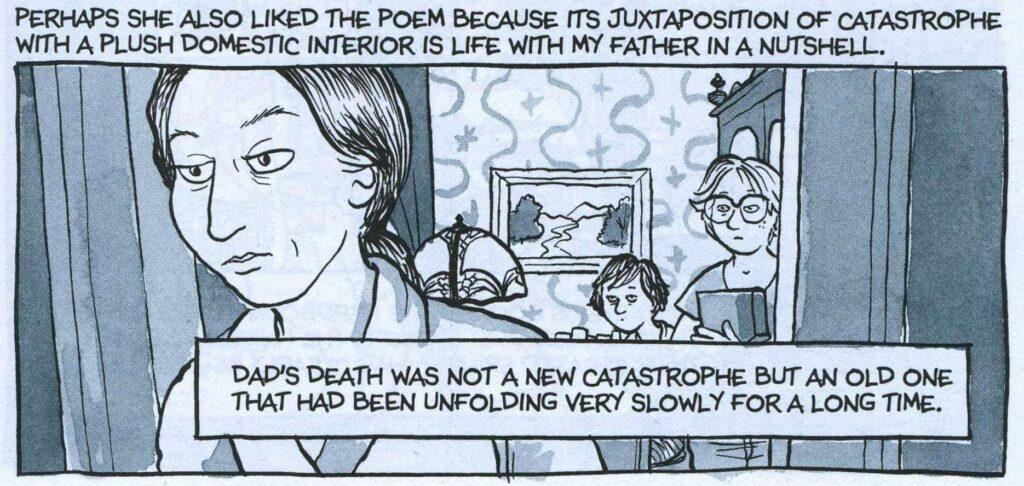
Are You My Mother? (2012)
In this second graphic memoir, Bechdel turns her feminist lens toward:
- Motherhood
- Psychoanalysis
- Emotional dependency
Drawing heavily on D. W. Winnicott, Bechdel examines how maternal relationships shape identity, creativity, and autonomy.
The Secret to Superhuman Strength (2021)
This later work uses Bechdel’s lifelong relationship with exercise as a metaphor for:
- Control
- Aging
- Spiritual longing
It reflects a mature feminist perspective that integrates body politics, ecology, and mortality.
Cultural Impact and Academic Legacy
Comics in the Academy
Bechdel’s work is now taught in:
- Literature departments
- Gender studies programs
- Art schools
- Psychology courses
She helped legitimize comics as serious scholarly objects, not merely pop artifacts.
Feminist Cartooning After Bechdel
Bechdel paved the way for:
- Autobiographical comics by women
- Queer graphic memoirs
- Intersectional storytelling
Artists like Alison Bechdel did not just open doors—she redesigned the building.
Criticism and Controversy
No feminist work exists without critique. Fun Home has faced:
- Censorship attempts in schools
- Accusations of elitism
- Discomfort over its portrayal of family
These controversies underscore the book’s power: it forces readers to confront uncomfortable truths about sexuality, family, and silence.
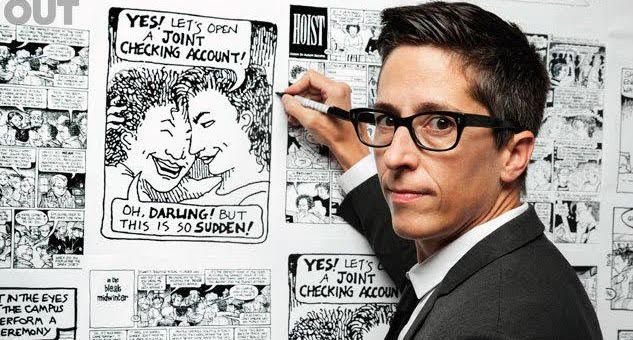
The Feminist Cartooning of Alison Bechdel: Alison Bechdel and the Feminist Power of Attention
Alison Bechdel’s feminist cartooning is not loud, simplistic, or slogan-driven. Its radicalism lies in attention:
- Attention to memory
- Attention to language
- Attention to space
- Attention to contradiction
By drawing her life with intellectual rigor and emotional honesty, Bechdel demonstrated that feminism is not only about protest—but about seeing clearly.
Fun Home endures not because it offers easy answers, but because it models a way of thinking: careful, self-critical, and deeply humane.
In the history of comics—and feminist art more broadly—Alison Bechdel stands not merely as a chronicler of her time, but as one of its most incisive theorists, drawing the private into public consciousness with unmatched clarity.
Read also: The Top 10 Must-Read Graphic Novels for Every Comic Enthusiast and 25+ Most Famous Cartoonists from Around the World (Open list) (0 submissions)
FAQ about The Feminist Cartooning of Alison Bechdel
1. Who is Alison Bechdel, and why is she significant in feminist cartooning?
Alison Bechdel is a renowned cartoonist known for her contributions to feminist cartooning. She gained recognition for her comic strip “Dykes to Watch Out For” and her graphic memoir “Fun Home,” which explored themes of sexuality, identity, and family. Bechdel’s work has profoundly impacted feminist literature and the acceptance of comics as a legitimate form of storytelling.
2. What is “Fun Home,” and why is it considered a feminist work?
“Fun Home” is Alison Bechdel’s graphic memoir that delves into her journey of self-discovery, particularly her realization of being a lesbian. It also explores her complex family dynamics, including her father’s repressed homosexuality. The memoir is considered feminist because it tackles sexuality, family, and gender roles, aligning with feminist perspectives.
3. How did “Fun Home” contribute to accepting graphic novels as literature?
“Fun Home” was pivotal in legitimizing graphic novels as a form of literature. Its critical acclaim, inclusion in college curricula, and adaptation into a Tony Award-winning Broadway musical helped elevate the status of graphic novels in the literary world.
4. What are some recurring themes in Alison Bechdel’s work?
Bechdel’s work often explores sexuality, identity, family dynamics, gender roles, and literary and artistic references. Her comics engage with these themes in a thought-provoking and reflective manner.
5. Are there other notable works by Alison Bechdel besides “Fun Home”?
Yes, Bechdel has created other significant works, including “Are You My Mother? A Comic Drama” (2012), which focuses on her relationship with her mother, and “The Secret to Superhuman Strength” (2021), a graphic memoir about her lifelong interest in fitness and identity.
6. How has Alison Bechdel influenced contemporary feminist cartoonists?
Alison Bechdel’s fearless exploration of personal and feminist themes has inspired a new generation of cartoonists to use the medium for meaningful storytelling. Her ability to blend the individual with the political has had a lasting impact on feminist cartooning.
7. What is the enduring legacy of Alison Bechdel in feminist cartooning?
Alison Bechdel’s legacy in feminist cartooning is characterized by her ability to push the boundaries of the medium, challenge societal norms, and inspire introspection and understanding. Her work serves as a touchstone for those seeking self-discovery, family, and identity narratives.
This post was created with our nice and easy submission form. Create your post!







.jpg)
3 Comments