

 Jacob Wright

Fujiko Fujio (藤子 不二雄) is the collective pen name of childhood friends Hiroshi Fujimoto (藤本 弘; Dec 1, 1933 – Sept 23, 1996) and Motoo Abiko (安孫子 素雄; Mar 10, 1934 – Apr 6, 2022). Debuting professionally in 1951, they published together—and sometimes individually—under one shared name from 1953 to 1988. The duo created many of Japan’s most beloved children’s series, including Obake no Q‑Tarō, Ninja Hattori‑kun, Kaibutsu‑kun, Perman, Kiteretsu Daihyakka, and the global icon Doraemon. In 1988 they formally parted ways (amicably and for health/creative reasons) and continued solo as Fujiko F. Fujio (Fujimoto) and Fujiko Fujio A (Abiko).
Their storytelling fused morality tales with a subversive, wry sense of humor: Fujimoto leaning toward speculative science fiction and wonder, Abiko toward surrealism and black comedy.
Infobox: Fujiko Fujio (Duo)
| Members | Hiroshi Fujimoto (Fujiko F. Fujio); Motoo Abiko (Fujiko Fujio A) |
| Active (as one pen name) | 1953–1988 |
| Debut | 1951 (Tenshi no Tama‑chan serialization) |
| Best known for | Doraemon, Obake no Q‑Tarō, Ninja Hattori‑kun, Kaibutsu‑kun, Perman, Kiteretsu Daihyakka |
| Key influences | Osamu Tezuka, plus Western comics and animation |
| Honors | Multiple Shogakukan Manga Awards; Tezuka Osamu Cultural Prize honors (F & A); Doraemon recognized as a modern cultural icon of Japan |
| Museums | Fujiko F. Fujio Museum (Kawasaki, opened Sept 3, 2011) |
Pen Names & Eras (At‑a‑Glance)
- 1951–1952 — Published as “Abiko Motoo, Fujimoto Hiroshi.”
- 1952–1953 — Adopted early joint pen name Ashizuka/Azhizuka Fujio.
- 1953–1988 — Fujiko Fujio (shared pen name for both collaborative and individual works).
- 1988– — Fujiko Fujio A (Abiko).
- 1989– — Fujiko F. Fujio (Fujimoto; official notation 藤子・F・不二雄).
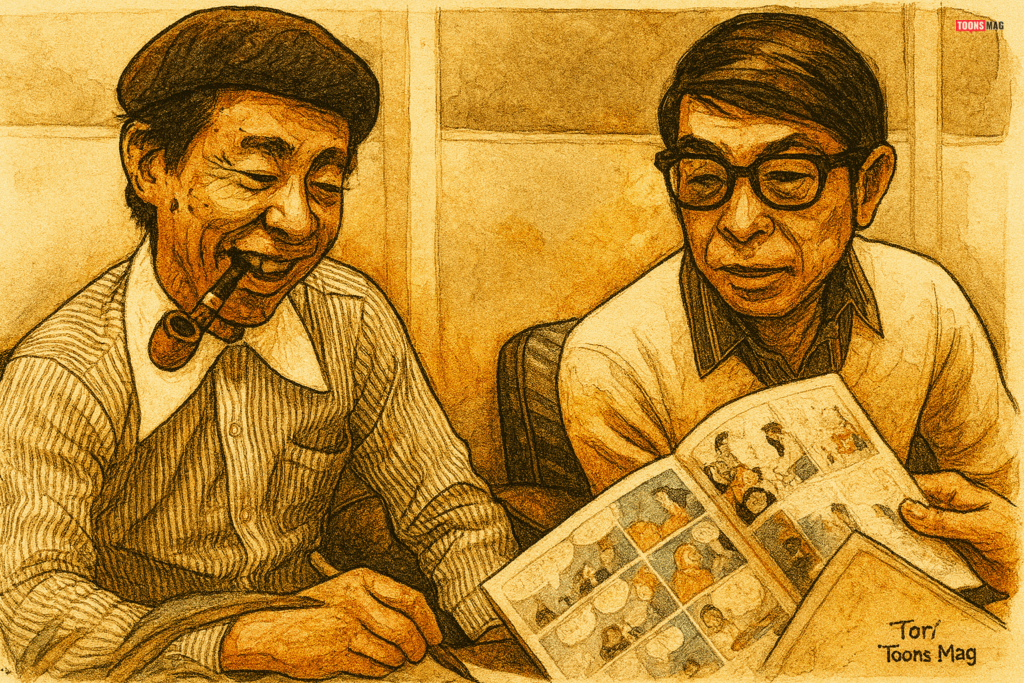
Common error: “Fujiko A. Fujio” is a misspelling; Abiko’s correct credit is Fujiko Fujio A (藤子不二雄Ⓐ).
Simple Era Table
| Era | Fujimoto | Collaboration | Abiko |
| 1951–1952 | “Fujimoto Hiroshi” | “Abiko Motoo, Fujimoto Hiroshi” | “Abiko Motoo” |
| 1952–1953 | Ashizuka/Azhizuka Fujio | Ashizuka/Azhizuka Fujio | Ashizuka/Azhizuka Fujio |
| 1953–1988 | Fujiko Fujio | Fujiko Fujio | Fujiko Fujio |
| 1988– | — | — | Fujiko Fujio A |
| 1989– | Fujiko F. Fujio | — | — |
Biography
Childhood, Friendship & First Submissions
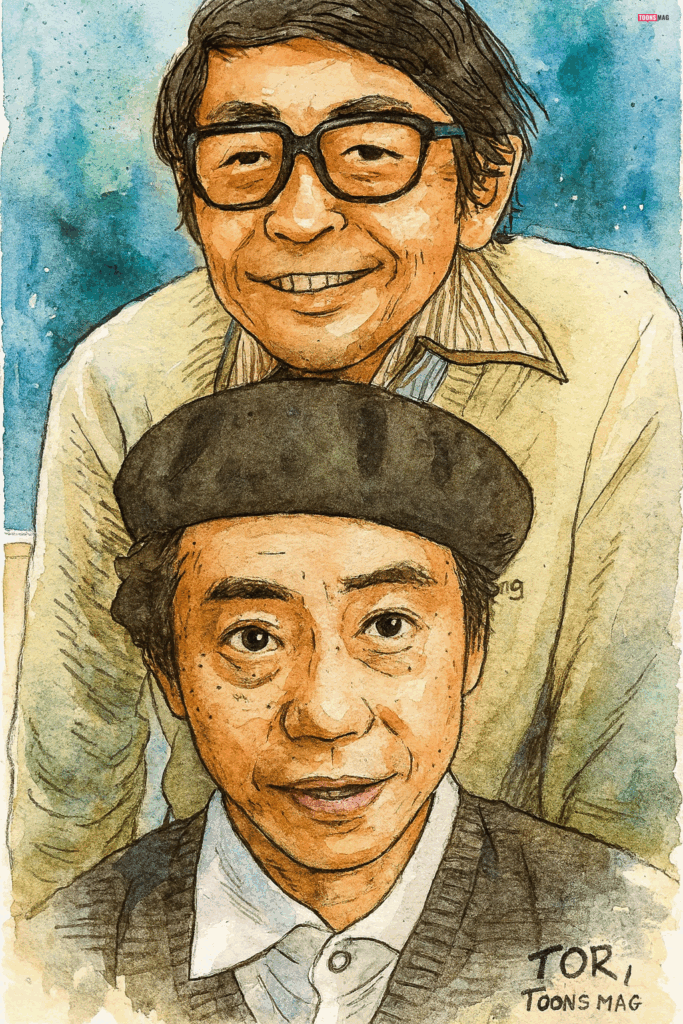
Both artists grew up in Toyama Prefecture—Fujimoto in Takaoka (b. 1933) and Abiko in Himi (b. 1934), in postwar Japan where manga became both entertainment and inspiration for many children. They met when Abiko transferred to Fujimoto’s elementary school and noticed him sketching elaborate scenes in a notebook; intrigued, Abiko struck up a conversation that led to a lasting friendship and creative bond.
In junior high, Osamu Tezuka’s Shin Takarajima electrified them, revealing the cinematic possibilities of manga storytelling. Determined to improve their craft, Fujimoto constructed a homemade episcope from scrap materials to project images for tracing and study, while Abiko developed scenarios and practiced lettering. Together they created Tenkūma, their first collaborative piece—an adventurous tale that blended humor with fantasy.
They also opened a joint Japan Post savings account to cover the cost of art supplies, travel to meet editors, and postage for submissions, agreeing to split income and expenses evenly—a disciplined, trust‑based arrangement that endured for decades and helped professionalize their partnership from the very beginning.
Debut & Early Pen Names (1951–1954)
In high school they debuted with Tenshi no Tama‑chan (1951) in the Mainichi Shogakusei Shimbun, a lighthearted slice‑of‑life comedy strip that resonated with elementary readers and showcased their knack for expressive character work. That same year they visited Tezuka in Takarazuka—making a long train journey to meet their idol—and proudly showed him elaborate illustrations for Ben‑Hur, adapted from the American epic novel.
Tezuka later recalled being struck by the ambition and polish of their work, noting he “saw the glimmer of future stars” in their pages. Initially they signed as “Tezuka Fujio,” an homage to their mentor, but soon adjusted to Ashizuka/Azhizuka Fujio to preserve respect while avoiding the appearance of directly copying Tezuka’s name; this change also marked their growing awareness of building their own professional identity.
Moving to Tokyo & Tokiwa‑sō (1954–1959)
As eldest sons, both briefly took day jobs after graduating in 1952—Fujimoto at a confectionery company where he decorated packaging illustrations, and Abiko at the Toyama Newspaper as a junior reporter and cartoon contributor. Fujimoto resigned within days, convinced that pursuing manga full‑time was his calling, while Abiko juggled work and drawing until the lure of Tokyo’s creative scene pulled him in. After a short‑lived serial, they made a critical breakthrough with the post‑apocalyptic SF story UTOPIA: The Last World War (1953), a bold narrative mixing war allegory with speculative technology that caught industry attention.
In 1954 they moved to Tokyo, first renting a tiny two‑tatami room above a watch shop—barely enough space for two futons and a drafting table—and later joining Tokiwa‑sō, the legendary apartment complex for up‑and‑coming artists (vacated by Tezuka). Life there meant daily artistic exchange with peers, late‑night brainstorming sessions, and mutual critique. They co‑founded the New Manga Party (Shin Manga‑tō) with figures like Hiroo Terada to champion innovative, youth‑driven comics. Abiko also assisted Tezuka on multiple occasions, notably creating the blizzard effect for a Jungle Emperor page.
A brutal missed‑deadlines episode over New Year 1955—when illness, overcommitment, and inexperience collided—temporarily damaged their professional standing, but resilience and a string of new commissions saw them recover, eventually relocating to Kawasaki by 1959 to be closer to Tokyo’s publishing hubs while enjoying a more stable home base.

Company, Studio & TV Era (1960s–1970s)
They founded Fujiko Studio Co., Ltd. in the 1960s to manage their rapidly expanding workload, licensing, and merchandising deals. In 1963 they co‑founded Studio Zero with Shin’ichi Suzuki, Shōtarō Ishinomori, Jirō Tsunoda, and others; Fujio Akatsuka later joined, bringing his trademark absurdist humor. At its peak, the studio employed around 80 staff, producing TV animation, experimental shorts, and even ghost‑producing a polished episode of Astro Boy for Mushi Production—a testament to their technical skill and industry trust.
Studio Zero became a creative hub where manga artists exchanged ideas across genres, influencing the stylistic diversity of 1960s anime. These were boom years: Obake no Q‑Tarō not only became a national phenomenon in print but also leapt to TV, driving a merchandising boom and spawning a craze for ghost‑themed children’s characters. During this period, Fujimoto married in 1962 and Abiko in 1966, balancing family life with an intense production schedule.
- Abiko’s 1968 pivot: he began exploring adult‑leaning, surreal, and black‑comedy works such as The Black Salesman (later The Laughing Salesman), Matarō ga Kuru!!, and Pro Golfer Saru—series that often critiqued postwar consumerism and human folly.
- Fujimoto’s focus: he concentrated on science‑tinged children’s adventures and humane SF, weaving stories of moral choice and gadget‑driven wonder, reinforcing the sense of curiosity and optimism that defines much of his solo work.
Doraemon & Global Reach (1969–1980s)
Doraemon launched in 1969 in multiple magazines, initially in short-run serials that tested the waters with young readers. From 1974, thanks to consistent publication in Shogaku grade-school magazines, it exploded in popularity among children, spawning toys, stationery, and even educational tie-ins. In 1977, CoroCoro Comic was created partly to showcase Fujiko Fujio works, with Doraemon as its flagship, helping cement the magazine’s identity as a home for gag and adventure series. With TV Asahi’s 1979 anime reboot—featuring a warmer tone, more consistent character designs, and a now-iconic voice cast—the duo’s catalog surged across media, driving yearly theatrical films starting in 1980.
Multiple titles—Perman, Ninja Hattori‑kun, Kiteretsu Daihyakka—were serialized and animated through the 1980s, each developing strong fan followings, though distribution was uneven outside Japan. While Doraemon became the most internationally recognized (and remains the only series with broad official English-language releases, including dubbed TV episodes, films, and bilingual manga), others such as Perman and Ninja Hattori‑kun aired mainly in Asia with limited English exposure. The franchise also inspired educational projects, international exhibitions, and government cultural promotions. Decades later, Bones adapted Fujimoto’s Time Patrol Bon for Netflix, a rare revival of a relatively obscure sci-fi adventure that demonstrated the enduring appeal and adaptability of their lesser-known works.
Separation & Solo Careers (1988–1996/2022)
The partners formally ended their joint brand in 1988, after 35 years of collaboration, reportedly to resolve creative direction and intellectual property rights issues, and because Fujimoto’s health was in noticeable decline due to chronic illness. The split was amicable, with both publicly affirming mutual respect and pledging to preserve the legacy of their shared works.
They continued creating under separate imprints, each leaning into their established personal strengths:
- Fujiko F. Fujio (Fujimoto) — continued Doraemon, developed Chimpui, Esper Mami, T.P. Bon, Kiteretsu Daihyakka, and an array of SF shorts and one‑shots exploring time travel paradoxes, parallel lives, extraterrestrial contact, and moral dilemmas for young readers. His works in this period often balanced accessible humor with deeper ethical thought experiments, and he maintained close editorial ties with Shogakukan.
- Fujiko Fujio A (Abiko) — produced new runs of Ninja Hattori‑kun, expanded The Laughing Salesman into multiple formats, created sports satire Pro Golfer Saru, industry memoir Manga Michi (a semi‑autobiographical manga‑about‑making‑manga), Ultra B, and a range of darker satire series and shorts. Abiko’s solo period leaned more into surreal, ironic, and sometimes unsettling social commentary, reflecting his fascination with human folly and postwar consumerism.
Fujimoto died of liver failure on Sept 23, 1996. Abiko died of natural causes in Kawasaki on Apr 6, 2022.
Key Works (Selected)
Collaboration (as Fujiko Fujio)
- Tenshi no Tama‑chan (1951–52)
- 4‑Man‑nen Hyōryū** / Drifting for 40,000 Years** (1953)
- UTOPIA: Saigo no Sekai Taisen / Utopia: The Final World War (1953)
- Prince of the Sea (Umi no Ōji) (1959–65)
- Obake no Q‑Tarō (1964–66; later revivals)
- Pāman (Perman) (1966–68; 1983–86)
- Shin Obake no Q‑Tarō (1971–73; 1976)
- Senbē (1971–72)
Fujiko F. Fujio (Fujimoto solo)
- Tebukuro Tetchan (1960–63)
- Susume Roboket (1961–65)
- 21 Emon (1967–69; 1981)
- Umeboshi Denka (1968–70)
- Mojacko (1969–70)
- Doraemon (1969–88)
- Pokonyan / Rocky Rackat! (1970–78)
- Jungle Kurobē (1973)
- Esper Mami (1976–83)
- Chūnen Superman Saenai‑shi (1977–78)
- T.P. Bon (1978–85)
- Mira‑kuru‑1 (1979)
- Chimpui (1985–88)
Fujiko Fujio A (Abiko solo)
- Wagana wa X‑kun (1957–58; 1959–62)
- Fūta‑kun (1964–67)
- Ninja Hattori‑kun (1964–68; 1981–88)
- Kaibutsu‑kun (1965–69; revivals 1972, 1980–82)
- The Black Salesman → The Laughing Salesman (1968; 1969–71; 1989–95, etc.)
- Matarō ga Kuru!! (1972–75)
- Pro Golfer Saru (1974–80; 1982–88)
- Manga Michi (1977–82; 1986–88)
- Ultra B (1984–88)
- Parasol Hembē (1989–91)
- SARU (1998–2005)

Awards & Honors (Highlights)
- Shogakukan Manga Award — multiple wins, including 1963 (for outstanding children’s manga) and 1982 for Doraemon, with judges citing the series’ cultural influence and moral storytelling.
- Japan Cartoonists Association honors — various accolades recognizing lifetime contribution, innovation in children’s comics, and the duo’s impact on subsequent generations of manga artists.
- Tezuka Osamu Cultural Prize — major awards for Doraemon (F), celebrating its imaginative scope and educational value, and a Special Prize for Manga Michi and related autobiographical works (A), praised for chronicling the history of postwar manga.
- Multiple Golden Gross film prizes — awarded to several Doraemon movies (F) for box office success and enduring popularity, often accompanied by commendations for advancing Japanese animation globally.
Legacy & Impact
- Cultural Icon — Doraemon is officially recognized as a symbol of modern Japanese pop culture, appointed by Japan’s Foreign Ministry in 2008 as the country’s first “anime ambassador” to promote cultural diplomacy worldwide. Statues, murals, and themed events can be found not only across Japan but in overseas exhibitions, symbolizing the character’s global reach.
- Two Voices, One Brand — The shared pen name masked two distinct worldviews: Fujimoto’s humane, science‑curious optimism, often centered on moral dilemmas and futuristic inventions, and Abiko’s sardonic, satirical edge, with biting commentary on human nature and postwar society.
- Cross‑media pioneers — From manga to TV anime, merchandising, film, stage shows, educational campaigns, and even video games, their series helped define the interconnected media ecosystem that later powered global franchises like Pokémon and One Piece.
- Museums & Memory — The Fujiko F. Fujio Museum in Kawasaki preserves original art, a reconstructed studio, and exhibits spanning both creators’ careers, hosting rotating exhibitions, interactive zones for children, and archival screenings of rare animated shorts.
Timeline (Selected)
- 1933/1934 — Fujimoto and Abiko born in Toyama Prefecture
- 1951 — Professional debut (Tenshi no Tama‑chan)
- 1953 — Adopt Fujiko Fujio pen name
- 1954 — Move to Tokyo; later settle at Tokiwa‑sō
- 1959 — Relocate to Kawasaki (Kanagawa)
- 1963 — Found Studio Zero
- 1964–66 — Obake no Q‑Tarō hits; TV adaptations follow
- 1969 — Doraemon begins
- 1974–79 — Children’s magazine and TV anime expansions; TV Asahi begins Doraemon broadcast (1979)
- 1988–89 — Duo brand dissolves; Fujiko Fujio A and Fujiko F. Fujio pen names continue
- 1996 — Fujimoto dies (liver failure)
- 2011 — Fujiko F. Fujio Museum opens (Kawasaki)
- 2022 — Abiko dies (natural causes)
Frequently Asked Questions
Why did they split the pen name?
To clarify rights and creative identities—and because Fujimoto’s illness made joint scheduling hard—while preserving lifelong friendship and mutual respect.
Which works reached English‑speaking audiences?
Doraemon is the primary series with official English releases; others (e.g., Perman, Ninja Hattori‑kun) aired mainly in Asia with limited English dubbing.
How do their solo styles differ?
Fujimoto (F): hopeful SF, ethical puzzles, gadgets/time travel as character catalysts.
Abiko (A): satire and black humor, ordinary people in surreal predicaments, and industry self‑reflection (Manga Michi).