

 Della Holman

Scott Adams (b. 1957) is an American cartoonist, writer, entrepreneur, and political commentator best known as the creator of Dilbert, the satirical comic strip that lampoons corporate culture. Emerging from a background in economics and business management, Adams transitioned from an office worker to a globally syndicated cartoonist, then later to a provocative voice in politics and media. With over four decades of influence, Adams has drawn praise for his insights into workplace absurdities and drawn criticism for controversial views on race, politics, and public health.
Infobox: Scott Adams
Name: Scott Raymond Adams
Date of Birth: June 8, 1957
Place of Birth: Windham, New York, United States
Profession: Cartoonist, Author, Entrepreneur, Political Commentator
Years Active: 1989–present
Education: B.A. in Economics, Hartwick College (1979); M.B.A., University of California, Berkeley (1986)
Famous Works: Dilbert, The Dilbert Principle, How to Fail at Almost Everything and Still Win Big, Win Bigly
Spouses: Shelly Miles (m. 2006; div. 2014), Kristina Basham (m. 2020; div. 2022)
Website: scottadams.locals.com
Early Life and Education
Scott Adams was born on June 8, 1957, in the small town of Windham, New York, nestled in the Catskill Mountains. From a young age, he demonstrated a notable talent for drawing and storytelling, often sketching comic strips and humorous caricatures of his family and classmates. Inspired by Charles Schulz’s Peanuts, Adams began cartooning at the age of six and won his first local drawing competition by the age of eleven, which helped reinforce his passion for visual storytelling. His creative instincts were evident early on, as he would spend hours crafting cartoon panels and imagined dialogues.

Raised in a modest working-class family, Adams later described his ethnic background as a mix of German, English, Irish, Welsh, Dutch, and Scottish, and at one time believed he had Native American ancestry—though later DNA testing disproved this. His upbringing in rural New York contributed to a sense of observational humor and self-reliance that would permeate his later work.
Adams graduated as valedictorian of his class from Windham-Ashland-Jewett Central School in 1975, where his academic diligence stood out among a small graduating class of 39 students. He then enrolled at Hartwick College in Oneonta, New York, where he pursued a Bachelor of Arts in Economics, graduating in 1979. While at Hartwick, Adams continued to explore creative writing and cartooning informally, even though he did not yet see a clear path to turning those interests into a profession.
Shortly after graduation, Adams relocated to California to seek broader professional opportunities. There, he pursued an advanced degree at the University of California, Berkeley, where he earned his M.B.A. in economics and management in 1986. During this time, Adams also took Dale Carnegie Training, a program he credits with significantly improving his communication and leadership abilities, which later shaped both his public speaking and writing styles. His intellectual curiosity led him to become a member of Mensa for several years, reflecting his lifelong interest in learning, logic, and complex problem-solving.
Career
Adams worked closely with telecommunications engineers at Crocker National Bank in San Francisco between 1979 and 1986. Upon joining the organization, he entered a management training program after being held at gunpoint twice in four months as a teller. Over the years, his positions included management trainee, computer programmer, budget analyst, commercial lender, product manager, and supervisor.
Adams created Dilbert during this period; the name came from ex-boss Mike Goodwin. Dogbert, originally named Dildog, was loosely based on his family’s deceased pet beagle Lucy. Submissions to various publications of both Dilbert and non-Dilbert comic panels failed to win publication. These included The New Yorker and Playboy. An inspirational letter from a fan, however, persuaded Adams to keep trying.
He worked at Pacific Bell between 1986 and June 1995; the personalities he encountered there became the inspiration for many of his Dilbert characters. Adams first published Dilbert with United Media in 1989, while still employed at Pacific Bell. He had to draw his cartoons at 4 a.m. in order to work a full day at the company. His first paycheck for Dilbert was a monthly royalty check of $368.62. Gradually, Dilbert became more popular and was published by 100 newspapers in 1991, and 400 by 1994. Adams attributes his success to his idea of including his e-mail address in the panels, thus facilitating feedback from readers.
Full-time cartoonist
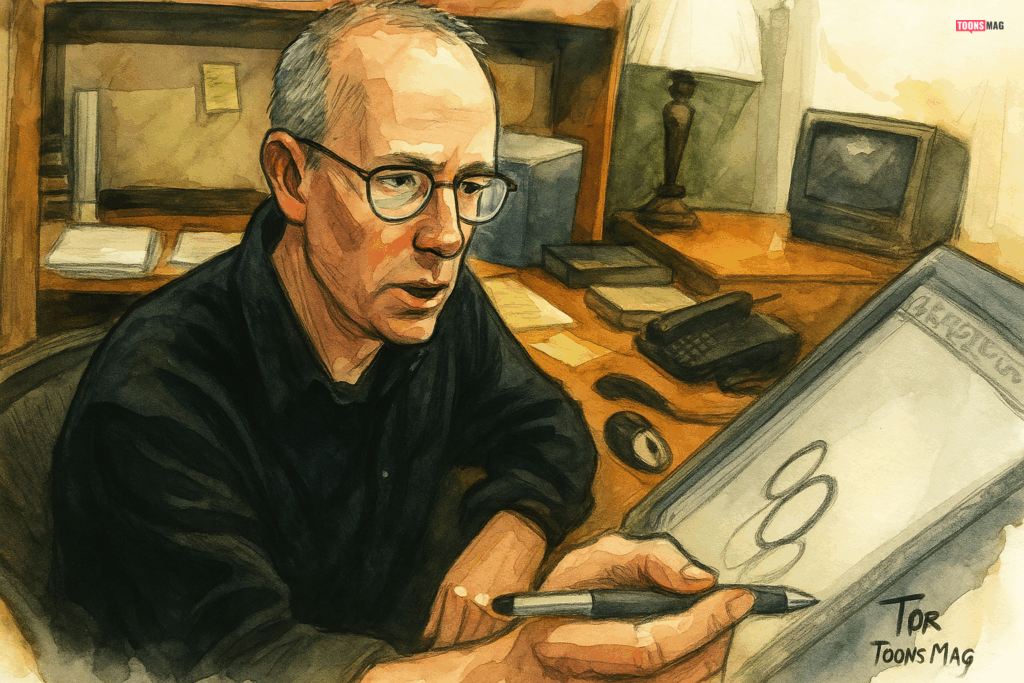
Adams’s success grew, and he became a full-time cartoonist with Dilbert in 800 newspapers. In 1996, The Dilbert Principle was released, his first business book.
Logitech CEO Pierluigi Zappacosta invited Adams to impersonate a management consultant, which he did wearing a wig and false mustache. He tricked Logitech managers into adopting a mission statement that Adams described as “so impossibly complicated that it has no real content whatsoever”. That year, he won the National Cartoonists Society’s Reuben Award for Outstanding Cartoonist of the Year, and Best Newspaper Comic Strip of 1997, the most prestigious awards in the field.
In 1998, Dilbert began as a TV series, but was canceled in 2000. By 2000, the comic was in 2,000 newspapers in 57 countries and 19 languages.
Finally, I got the call. “You’re number one.” I still haven’t popped the champagne. I just raise the bar for what would be the right moment, and tell myself how tasty it will be if I ever accomplish something special in my work. Apparently the thing inside me that makes me work so hard is the same thing that keeps me unsatisfied.
Adams was a fan of the science fiction TV series Babylon 5, and he appeared in the season 4 episode “Moments of Transition” as a character named “Mr. Adams” who hires former head of security Michael Garibaldi to locate his megalomaniacal dog and cat. He also had a cameo in “Review”, a third-season episode of the TV series NewsRadio, in which Matthew Brock (played by Andy Dick) becomes an obsessed Dilbert fan. Adams is credited as “Guy in line behind Dave and Joe in first scene”.
Adams is the CEO of Scott Adams Foods, Inc., makers of the Dilberito and Protein Chef, and a co-owner of Stacey’s Café in Pleasanton, California.
Corporate Career and Birth of Dilbert
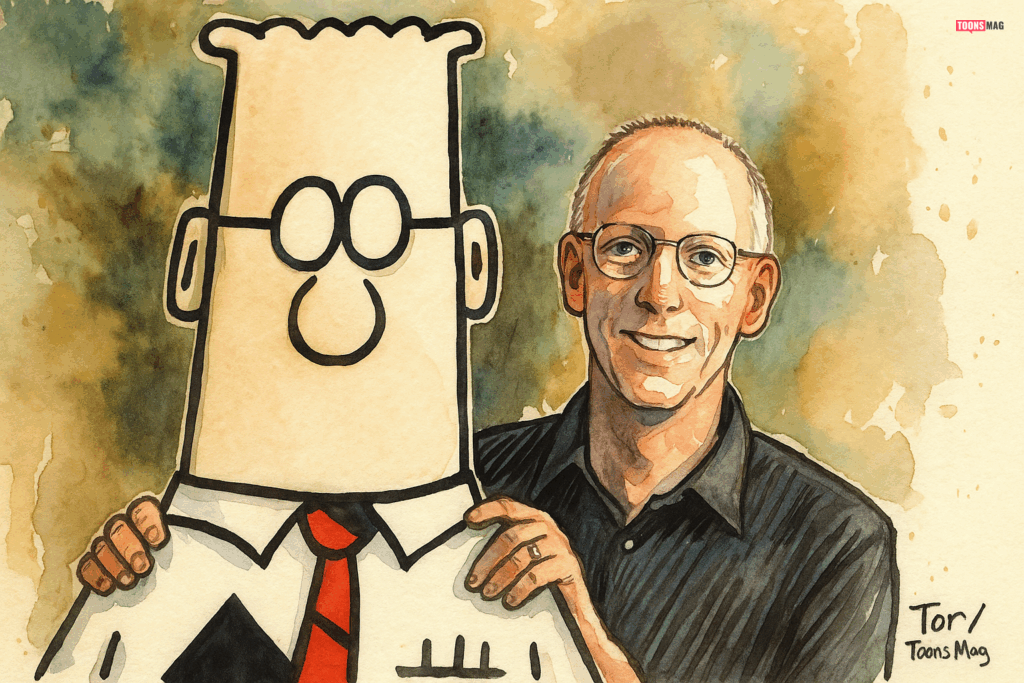
Adams began his professional career at Crocker National Bank in San Francisco, initially working as a teller. The role proved unexpectedly hazardous—he was held at gunpoint twice within a four-month span, prompting him to transfer into the bank’s management training program. This shift marked the beginning of a diverse and formative corporate journey. Between 1979 and 1986, Adams cycled through multiple roles including computer programmer, commercial lender, budget analyst, and product manager. Each position exposed him to a variety of bureaucratic inefficiencies, rigid hierarchies, and questionable managerial decisions—recurring themes that would later be immortalized in his comic strip.
In 1986, Adams joined Pacific Bell, a telecommunications company where he would remain for nearly a decade. His time there proved pivotal in shaping his creative vision. He often observed a disconnect between executive decisions and workplace realities, noting how jargon, micromanagement, and clueless leadership often disrupted productivity. These observations solidified the character templates and recurring gags in Dilbert, with many strip scenarios pulled directly from his lived experience.
Juggling a corporate job by day and cartooning during the early morning hours, Adams pursued his artistic ambitions with relentless discipline. He submitted comic panels to high-profile publications like The New Yorker and Playboy, though they were repeatedly rejected. His early cartoons included both Dilbert and unrelated single-panel gags. Although the submissions failed to garner publication, a heartfelt letter from a fan persuaded Adams to persevere. That encouragement led to his breakthrough in 1989, when United Media agreed to syndicate Dilbert.
Despite the deal, Adams maintained his day job for several years, rising at 4 a.m. daily to produce his comic strip before heading to the office. His first royalty check amounted to $368, but the modest earnings belied the strip’s eventual success. By 1991, Dilbert had been picked up by 100 newspapers, and by 1994 that number had grown to 400. Adams credits much of this growth to his innovative idea of publishing his email address alongside the strip, allowing readers to provide real-time feedback and submit workplace anecdotes that he could adapt into new material.
Rise to Prominence and Cultural Impact
By the mid-1990s, Dilbert had struck a chord with office workers disillusioned by downsizing, micromanagement, and corporate double-speak. By 1995, Adams left his job at Pacific Bell to cartoon full-time. In 1996, he published The Dilbert Principle, a bestselling business book that satirized managerial inefficiency. The same year, he impersonated a management consultant at Logitech, tricking executives into adopting a gibberish mission statement—a prank that won him the Orwell Award.
Dilbert reached over 2,000 newspapers in 57 countries and was translated into 19 languages. In 1999, it was adapted into a television series that aired for two seasons and won a Primetime Emmy. Adams was honored with the National Cartoonists Society’s Reuben Award and Best Newspaper Comic Strip that same year. He became a staple of business humor, publishing dozens of compilation books and spin-off guides.
Ventures, Media Appearances, and Public Influence
Scott Adams is more than a cartoonist—he is a polymath with ventures spanning food products, digital platforms, and self-help literature. In 1999, he founded Scott Adams Foods, Inc., which produced the “Dilberito,” a vegan burrito that attempted to combine nutrition with humor. Though commercially unsuccessful, it reflected Adams’ experimental spirit.
Adams co-founded WhenHub, a media tech company that offered video consulting services. He also launched the daily podcast Real Coffee with Scott Adams, which covers politics, persuasion, and productivity. The show gained a substantial following, with Adams frequently interviewing public figures and sharing controversial takes. Notable guests have included Naval Ravikant, Greg Gutfeld, and Kanye West.
His nonfiction writing often blends humor, personal anecdotes, and frameworks for success. Key titles include How to Fail at Almost Everything and Still Win Big (2013), Win Bigly (2017), Loserthink (2019), and Reframe Your Brain (2023). These works emphasize mindset over mechanics and advocate for building “talent stacks”—unique combinations of complementary skills.
Controversies and Fallout
While Adams initially drew praise for his wit and business insights, his commentary became increasingly controversial. He frequently weighed in on politics, identifying as “left of Bernie” on some issues but endorsing Mitt Romney in 2012 and Donald Trump in 2016. Adams became known for analyzing Trump’s “persuasion stack” and predicting his election victory.
In February 2023, Adams ignited outrage after commenting on a poll in which some Black respondents disagreed with the statement “It’s okay to be white.” He called Black Americans a “hate group” and advised white people to “get the hell away” from them. The comments were widely condemned, and major outlets including The Washington Post, USA Today, and The Los Angeles Times dropped Dilbert. Andrews McMeel Syndication severed ties, and Penguin Random House canceled an upcoming book. Adams claimed his remarks were hyperbolic and misinterpreted, but the damage to his reputation was significant.
Reinvention and Later Work
Following his fallout with mainstream media, Adams rebranded Dilbert as Dilbert Reborn, which is now available exclusively through his subscription-based platform on Locals.com. On this site, Adams publishes original cartoons, long-form essays, livestreams, and exclusive podcast content that delve into topics ranging from personal development to sociopolitical commentary. His digital audience includes fans who value his unapologetic tone, his critiques of mainstream narratives, and his staunch advocacy for freedom of speech and personal sovereignty. Many supporters credit him with fostering an alternative intellectual community where open dialogue is encouraged without institutional gatekeeping.
Critics, however, argue that Adams has increasingly veered into conspiratorial and ideologically charged territory, citing his commentary on race relations, public health policy, and political elites as evidence of radicalization. They accuse him of leveraging his platform to spread misinformation and normalize fringe viewpoints, prompting ongoing debates about the responsibility of influential public figures in digital spaces.
Beyond content creation, Adams mentors aspiring writers and illustrators, promoting his unique blend of affirmation-based self-improvement strategies. He teaches practical techniques for enhancing creativity, productivity, and personal branding, often emphasizing the power of repetition and visualization. These methods, which he claims played a key role in his own career success, are central themes in his coaching sessions and digital workshops.
Adams remains a frequent guest on podcasts and YouTube channels that span a wide ideological range, including libertarian, conservative, and independent outlets. He uses these appearances to expand on his theories of influence, persuasion, and cognitive framing, often engaging in spirited debates with hosts and audiences alike. Despite ongoing controversy, Adams has cultivated a resilient niche following that sees him as a trailblazer in the evolving media landscape.
Personal life
Adams is a former member of Mensa. In recent years, Adams has had two notable health problems. Since late 2004, he has suffered from a reemergence of focal dystonia, which has affected for lengthy periods his ability to draw on paper, though it causes no real problem now that he draws the comic on a graphics tablet. He also suffered from spasmodic dysphonia, a condition that causes the vocal cords to behave in an abnormal manner. He recovered from this condition temporarily, but in July 2008 underwent surgery to reroute the nerve connections to his vocal cords. The operation was successful, and Adams’ voice is now completely functional.
Adams is a vegetarian and trained as a hypnotist. He credits affirmations for many of his achievements, including Dilbert’s success and achieving a ninety-fourth percentile on a difficult qualification exam for business school, among other unlikely events. He states that the affirmations give him focus. He has described a method which he has used that he says gave him success. He pictured in his mind what he wanted, and wrote it down 15 times a day on a piece of paper.
In addition to his cartoon work, he has written two books on religion, God’s Debris (2001), and The Religion War (2004). God’s Debris lays out a theory of Pandeism, in which God blows itself up to see what will happen, which becomes the cause of our universe. In God’s Debris, Adams suggests that followers of theistic religions such as Christianity and Islam are inherently subconsciously aware that their religions are false, and that this awareness is reflected in their consistently acting like these religions, and their threats of damnation for sinners, are false. In a 2017 interview Adams said these books would be “his ultimate legacy”.
Adams married Shelly Miles in 2006. She has two children named Savannah and Justin Miles. In a February 2014 blog posting he revealed that he is no longer married. In an October 2018 blog post, he stated that his stepson had died of “almost certainly” an opioid overdose and called for volunteer sponsors to sign up on WhenHub to take calls from addicts in need.
Health and Personal Life
Adams has dealt with multiple health conditions throughout his life, which significantly impacted his career and personal resilience. He was diagnosed with focal dystonia, a neurological disorder that caused involuntary muscle contractions in his drawing hand. This condition initially hampered his ability to produce traditional pen-and-ink cartoons. Nevertheless, Adams demonstrated adaptability by transitioning to digital illustration using a graphics tablet, allowing him to continue producing Dilbert and other creative works without interruption. Additionally, he suffered from spasmodic dysphonia, a voice disorder that distorted his speech, affecting his ability to conduct public speaking and podcasting. In 2008, he underwent a specialized nerve surgery, which successfully restored full use of his voice—a critical tool for his growing media presence.
In May 2025, Adams made a sobering announcement on his podcast Real Coffee with Scott Adams, revealing that he had been diagnosed with terminal prostate cancer. The disease had metastasized to his bones and spine, leading to chronic pain and limited mobility. Despite exploring alternative treatments such as ivermectin and fenbendazole—popularized in fringe wellness communities—he reported that they had not yielded improvement. As a result, Adams now relies on a walker for mobility and candidly discusses his physical limitations with his audience. Remarkably, he has continued to engage with fans through his podcast and digital platforms, using humor, philosophical insight, and self-reflection to frame his final chapter with dignity and intellectual curiosity.
On the personal front, Adams has been married twice. His first marriage was to Shelly Miles in 2006, and they later divorced in 2014. In 2020, he married model and entrepreneur Kristina Basham, though the marriage ended in divorce in 2022. Adams was stepfather to Basham’s two daughters and continues to reside in Pleasanton, California. His reflections on family, loss—including the tragic death of his stepson due to a fentanyl overdose—and aging have become recurring themes in his later writings and podcast episodes, further deepening the personal dimensions of his public persona.
Politics
Adams has often commented on political matters. Despite this, in 2016 he wrote on his blog “I don’t vote and I am not a member of a political party.” In 2007, he suggested that Michael Bloomberg would make a good presidential candidate.
Before the 2008 presidential election he said, “On social issues, I lean Libertarian, minus the crazy stuff”, but said in December 2011 that, if he were president, he would do whatever Bill Clinton advised him to do because that “would lead to policies that are a sensible middle ground”. In a blog post from September 2017, Adams considers himself to be “left of Bernie [Sanders], but with a preference for plans that can work”.
On October 17, 2012, he wrote “while I don’t agree with Romney’s positions on most topics, I’m endorsing him for president”.
2016 United States presidential election
In 2015, although Adams stated that he would not endorse a candidate for the 2016 elections, he repeatedly praised Donald Trump’s persuasion skills, especially on his blog, extensively detailing what he called Trump’s “talent stack”, the then- candidate’s unusual skill set combination.
Adams correctly predicted Trump would win the Republican nomination and the general election; in the 2016 election campaign’s final weeks, except for a temporary reversal in early October, Adams repeatedly said Trump would win.
Adams has shared on his blog and elsewhere that men may feel emasculated by the nomination of a female candidate for president. Of the 2016 Democratic National Convention, he said the following: “If you’re an undecided voter, and male, you’re seeing something different. You’re seeing a celebration that your role in society is permanently diminished. And it’s happening in an impressive venue that was, in all likelihood, designed and built mostly by men.”
Adams said that he temporarily endorsed Hillary Clinton purely out of fear for his own life, stating he had received direct and indirect death threats (“Where I live, in California, it is not safe to be seen as supportive of anything Trump says or does. So I fixed that.”). In late September, however, Adams officially switched his endorsement from Clinton to Trump. Among his primary reasons for the switch were his respect for Trump’s persuasion skills over Clinton’s, Clinton’s proposal to raise the inheritance tax to 65%, and his concerns over Clinton’s health. Adams states that writing about Donald Trump ended his speaking career and reduced his income by about 40%.
Books and Publications
Scott Adams has published more than 40 books, including:
- The Dilbert Principle (1996)
- Dogbert’s Top Secret Management Handbook (1996)
- The Joy of Work (1998)
- How to Fail at Almost Everything and Still Win Big (2013)
- Win Bigly: Persuasion in a World Where Facts Don’t Matter (2017)
- Loserthink (2019)
- Reframe Your Brain (2023)
He has also released dozens of Dilbert collections, including:
- Always Postpone Meetings with Time-Wasting Morons (1992)
- Shave the Whales (1994)
- Still Pumped from Using the Mouse (1996)
- Dilbert 2.0: 20 Years of Dilbert (2008)
- Dilbert Turns 30 (2019)
Legacy
Scott Adams’ impact on workplace satire is profound and far-reaching. Dilbert not only defined an entire generation’s understanding of cubicle culture, managerial absurdity, and corporate disillusionment but also offered a mirror to the silent frustrations of office workers worldwide. The strip gave voice to those navigating corporate environments filled with contradictory policies, disengaged leadership, and opaque hierarchies. Its humor resonated deeply during the widespread downsizing era of the 1990s and continues to find relevance in modern conversations about work-life balance, remote employment, and managerial inefficiency. Dilbert became more than a comic strip; it evolved into a cultural commentary and even a coping mechanism for employees in monotonous or toxic workplaces.
While recent controversies have undeniably clouded parts of Adams’ legacy, his contributions to cartooning, business literature, and digital media remain substantial. His pioneering decision to include his email address in comic strips facilitated direct reader engagement long before social media platforms made that commonplace. His writing on success, productivity, and persuasion helped redefine the boundaries between humor and self-help, influencing aspiring creatives and entrepreneurs alike.
Through a blend of creativity, provocation, and unfiltered commentary, Adams has evolved from a cubicle-bound programmer to a polarizing media personality whose influence spans humor, business theory, and political discourse. His story reflects both the immense potential for personal reinvention in the digital age and the significant risks that come with unfiltered expression in an increasingly polarized world. His legacy—complex and multifaceted—serves as a case study in both the power and peril of leveraging creative success into a broader public platform.




One Comment