

 Simon Alexander

Theodor Seuss Geisel—known to millions around the world as Dr. Seuss—was not merely a writer and illustrator of children’s books. He was a cultural force. His rhymes, characters, and whimsical worlds transformed how children learn to read, how authors approach storytelling, and how art can mix joy with social commentary.
Behind the Cat in the Hat, the Grinch, Horton, and the Lorax, was a complex man: a satirist, a political cartoonist, an ad man, and a passionate advocate for literacy and morality. This in-depth biography explores the life, evolution, achievements, and legacy of Theodor Seuss Geisel, an artist whose nonsense made perfect sense.

Early Life and Education (1904–1927)
Theodor Seuss Geisel was born on March 2, 1904, in Springfield, Massachusetts, to German-American parents. His middle name, “Seuss,” was his mother’s maiden name. Though he later adopted it as a pen name, it’s worth noting that he pronounced it to rhyme with “voice” (a fact often ignored in favor of the rhyming pronunciation “Soose”).
Childhood Influences
- Raised near Springfield’s Forest Park Zoo, young Ted (as he was called) developed a love for animals and absurdity.
- His mother would chant rhymes to him at bedtime, a habit that deeply influenced his rhythmic style.
- His father, a brewmaster, later managed the zoo—further immersing Ted in a world of strange creatures.
Academic Path
- Geisel attended Dartmouth College, where he edited the Jack-O-Lantern humor magazine.
- After being caught drinking (during Prohibition), he was banned from extracurriculars. To continue writing, he adopted the pseudonym “Seuss.”
- Later, he briefly studied at Oxford University in England intending to become a professor. But a fellow student (and future wife) Helen Palmer encouraged him to pursue art instead.
Early Career: Advertising and Political Cartoons (1927–1940)
Geisel returned to the U.S. and began a successful career as a commercial illustrator and advertising writer, developing a unique style of quirky, exaggerated visuals and clever slogans.
Notable Highlights:
- Worked for Standard Oil for over 15 years, creating ads for Flit bug spray with the slogan: “Quick, Henry, the Flit!”
- Illustrated humorous articles for magazines like Judge, Life, and Vanity Fair.
Wartime Cartoons
In the 1940s, Seuss became a political cartoonist for PM, a New York newspaper. His cartoons were:
- Fiercely anti-fascist, anti-Hitler, and anti-isolationist.
- Often controversial, particularly his support for Japanese-American internment (a stance he later regretted and addressed in Horton Hears a Who!).
He later worked with the U.S. Army Signal Corps, producing propaganda films, including the Oscar-winning Design for Death (1947).
The Birth of Dr. Seuss, Children’s Author (1937–1957)
Though Geisel published his first children’s book, And to Think That I Saw It on Mulberry Street, in 1937, it took years and multiple rejections before he found real success.
A Publishing Breakthrough
In 1954, a Life magazine article lamented the lack of engaging books for early readers. In response, William Spaulding, an editor at Houghton Mifflin, challenged Seuss to write a book using no more than 250 easy words.
The result?
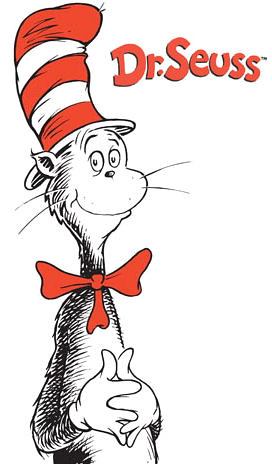
The Cat in the Hat (1957) — a revolution in children’s literacy.
This book:
- Introduced controlled vocabulary and engaging stories.
- Proved that learning to read didn’t have to be boring.
- Was followed by Green Eggs and Ham, Hop on Pop, and One Fish Two Fish Red Fish Blue Fish, all using simplified word sets.
Together with publisher Bennett Cerf, Seuss launched Beginner Books, a division of Random House that would shape generations of readers.
The Golden Era of Dr. Seuss (1957–1975)
Between 1957 and the mid-1970s, Geisel published many of his most iconic works—books that fused fantasy with deeper themes, often moral, political, or philosophical.
Iconic Titles and Themes:
- How the Grinch Stole Christmas! (1957)
A satire on consumerism and redemption. - Horton Hears a Who! (1954)
A statement on compassion and equality: “A person’s a person, no matter how small.” - The Sneetches (1961)
An allegory about racism, class, and the absurdity of prejudice. - The Lorax (1971)
Perhaps his most openly environmentalist book, warning of the dangers of unchecked capitalism and deforestation. - Oh, the Places You’ll Go! (1990)
His final book, a poetic, inspirational message for young adults and graduates.
Seuss’s stories, while whimsical on the surface, were often layered with sharp satire, empathy, and a profound sense of justice.
Personal Life
Dr. Seuss’s personal life was more complex than his joyous stories might suggest.
- He married Helen Palmer in 1927. She was a writer and staunch supporter of his career.
- After years of illness, Helen died by suicide in 1967, reportedly influenced by Ted’s affair with Audrey Stone Dimond, who he later married.
- Though he never had children of his own, he often said, “You have ‘em. I’ll entertain ‘em.”
Despite his public image as a fun-loving children’s author, Seuss was known to be intensely private, perfectionist, and sometimes politically polarizing.
Legacy and Cultural Impact
Theodor Seuss Geisel died on September 24, 1991, at the age of 87. But his legacy only grew after death.
Honors and Influence:
- More than 600 million copies of Dr. Seuss books have been sold.
- His works have been translated into over 20 languages.
- Numerous adaptations—TV specials, films, stage plays—have expanded his audience.
- The Dr. Seuss National Memorial stands in Springfield, Massachusetts.
Controversy and Reappraisal
In recent years, Seuss’s earlier works have come under scrutiny for racial stereotypes, particularly in political cartoons and lesser-known books like If I Ran the Zoo and Scrambled Eggs Super!.
In 2021, Dr. Seuss Enterprises ceased publication of six titles deemed racially insensitive. The move sparked global debate about cultural legacy, censorship, and evolving ethical standards.
Despite these complexities, most scholars agree that Seuss’s work—especially his later children’s books—promoted inclusion, environmentalism, anti-authoritarianism, and creativity.
Dr. Seuss (Theodor Seuss Geisel): The Enduring Power of Seuss
Dr. Seuss remains one of the most influential literary figures of the 20th century. His genius was in his ability to make the absurd feel profound and the moral feel magical. He trusted children to understand big ideas—equality, empathy, perseverance—without diluting them into condescension.
His legacy is a reminder that stories don’t have to be realistic to be true, and that nonsense, when done with care, can make the most sense of all.
“Unless someone like you cares a whole awful lot, nothing is going to get better. It’s not.”
— The Lorax, Dr. Seuss
This post was created with our nice and easy submission form. Create your post!